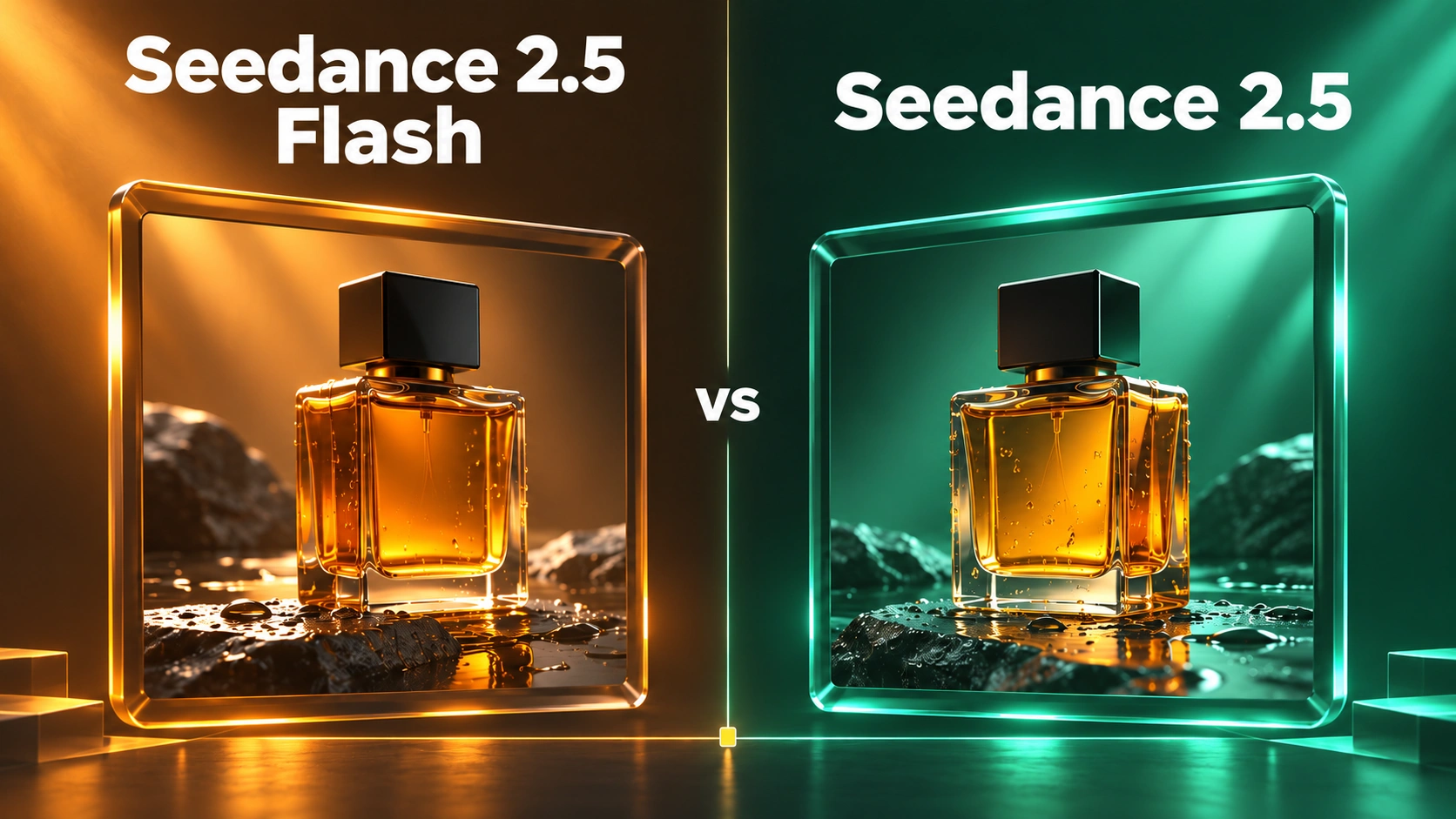
Seedance 2.5 Flash was cheaper per attempt and had a shorter median generation time in our tests. Standard Seedance 2.5 reached our basketball target for fewer total credits. Neither solved our robot scene’s exact layout within three attempts.
The practical choice in this Seedance 2.5 Flash vs Seedance 2.5 comparison depends on what your video must get right, and how many attempts it takes.
We generated 18 videos through JXP on November 17, 2026: three briefs, two models, and three unchanged attempts per brief per model. All used eight seconds at 720p. Below, compare the original first takes, review costs and reported times, and reuse the exact prompts.
Quick answer: which should you choose?
Choose Flash for a lower-cost first attempt at a focused 720p concept. In our perfume test, both models passed on the first attempt, making Flash the less expensive route to that result.
Consider standard Seedance 2.5 when a matched test shows it follows your essential action more directly, or when you need its additional resolution or reference options. It reached our basketball target on attempt one; Flash needed two.
For exact layouts and event sequences, budget for inspection and revision with either model. Paying more did not fix the misplaced window in our robot test.
A pass means the sampled frames met our essential visual criteria, not that every creative detail matched the brief.
Result from this test | Seedance 2.5 Flash | Seedance 2.5 |
|---|---|---|
Quote per 8-second, 720p video | 24 credits | 32 credits |
Median reported generation time | 174 seconds | 241 seconds |
Perfume: passing attempts | 2 of 3 | 3 of 3 |
Basketball: passing attempts | 1 of 3 | 2 of 3 |
Robot: passing attempts | 0 of 3 | 0 of 3 |
These counts describe this small sample, not general success rates. Assessment used sampled original frames, including dense sampling around the basketball action; audio and full continuous-motion quality were outside its scope.
Features and pricing: what is different?
These were the options and quotes visible in JXP on November 17, 2026. Availability and prices can change; check the quote before generating.
Comparison point | Seedance 2.5 Flash | Seedance 2.5 |
|---|---|---|
Resolution options shown | 480p, 720p | 480p, 720p, 1080p, 4K |
Duration control shown | 4–30 seconds | 4–30 seconds |
Maximum combined references listed | 20 | 50 |
Our test settings | 8 seconds, 720p, text-only | 8 seconds, 720p, text-only |
Quote per test video | 24 credits | 32 credits |
Three attempts on one brief | 72 credits | 96 credits |
At those quotes, Flash was 25% cheaper per attempt: an eight-credit saving on each eight-second video. A lower per-attempt price does not guarantee a lower cost to reach your brief.
The resolution and reference rows describe available settings, not capabilities we tested. All comparison videos below used 720p and no reference files. See the current Seedance 2.5 Flash settings and Seedance 2.5 settings for your intended workflow.
Test 1: product advertisement — Flash passed at a lower cost
The perfume brief required one consistent bottle, readable LUMA lettering, a change toward a three-quarter view, and an ending with the bottle on the left and space for copy on the right.
First-attempt comparison
Seedance 2.5 Flash | Seedance 2.5 |
|---|---|
What worked, and what changed across attempts
Both first attempts kept a single amber bottle with a black cap, readable LUMA lettering at the inspected checkpoints, and a left-side ending composition with space on the right. They also showed a change in viewpoint. Both passed.
Across all three attempts, Flash passed two of three attempts; standard passed all three. Flash’s third take preserved the label and copy space but stayed largely frontal, missing the requested move toward a three-quarter view. It was a plausible product shot, but it did not meet the camera-direction check.
For this concept, Flash reached its first passing result for 24 credits; standard reached its first passing result for 32 credits. Flash is a reasonable lower-cost starting point for a concept like this. Standard passed more consistently on this prompt, but three takes cannot establish broader reliability.
These were invented product concepts. Without a supplied product reference, readable LUMA text does not demonstrate fidelity to a real bottle or brand asset.
Test 2: basketball action — standard reached the target for less
The basketball brief tested a detail that an attractive preview can hide: whether the ball visibly contacts the court exactly once before returning to the player’s hands.
First-attempt comparison
Seedance 2.5 Flash | Seedance 2.5 |
|---|---|
Why standard reached the target for fewer credits
Flash’s first attempt showed two down-and-up ball cycles instead of one, with apparent reversals above the court. The person and setting were convincing enough at a glance, but the action failed the brief.
Standard’s first attempt showed one visible contact and rebound into a catch, followed by a turn and smile. It added a full-body rotation before the final pose. It passed, although the extra rotation departed from the intended performance.
Flash’s second attempt passed: dense sampling around the contact interval showed one court contact and rebound into a two-handed catch, followed by a turn and smile with the subject and ball visible. Standard’s second also passed. Neither third attempt provided a confirmed visible floor contact in the inspected action frames; standard’s third additionally shifted the tracksuit toward teal rather than the requested cobalt.
Flash passed one of three attempts, while standard passed two of three. Flash reached its first passing result on attempt two, costing 48 credits cumulatively. Standard reached its first passing result on attempt one, costing 32 credits.
Standard therefore reached a passing result for 16 fewer credits, despite its higher price per generation. For clips with essential physical actions, inspect the contact event before accepting a result. A polished final pose can hide a missed bounce earlier in the shot.
Test 3: robot story — neither model solved the layout
The robot brief asked for a delivery through a door slot, followed by a light in a window directly above the door. The window’s location was an essential requirement, not a decorative preference.
First-attempt comparison
Seedance 2.5 Flash | Seedance 2.5 |
|---|---|
A shared failure that a higher price did not fix
Both models produced recognizable yellow postal robots, red doors, and envelope-delivery imagery. However, the inspected outputs placed the window within the upper part of the door, or framed the scene too tightly to keep the required separate window visible.
Across all six robot generations, neither model met the complete layout and visibility checks. Later takes could show a warm light after delivery while still getting the architecture wrong. Correct-looking event order did not compensate for the missing spatial relationship.
After three attempts, the spend was 72 credits for Flash and 96 for standard, and neither model passed the robot test. Standard’s higher price did not resolve this brief.
For a follow-up, we would simplify the scene or supply a layout reference before spending on more unchanged retries. That is a proposed next step; reference-guided improvement was not tested here.
Which Model Cost Less to Reach an Acceptable Result?
Here, an acceptable result means a passing result under the criteria defined above. The table shows the cumulative cost to the first passing attempt.
Brief | Flash: first passing result | Standard: first passing result |
|---|---|---|
Perfume | Attempt 1 — 24 credits | Attempt 1 — 32 credits |
Basketball | Attempt 2 — 48 cumulative credits | Attempt 1 — 32 credits |
Robot | Not reached in 3 attempts — 72 spent | Not reached in 3 attempts — 96 spent |
We spent 504 credits across all 18 generations: 216 on Flash and 288 on standard. Those totals include repeats generated after a passing result so that each brief had equal coverage.
For your own budget, set acceptance criteria before generating. Treat essential details as requirements when reviewing each output, then compare the cumulative cost of reaching them.
Speed: Flash had a lower median, but did not win every pair
Flash had a lower median reported generation time in this session: 174 seconds, compared with 241 seconds for standard. That is a roughly 28% lower median time, measured against standard’s median.
Brief and attempt | Flash | Standard |
|---|---|---|
Perfume 1 | 174 s | 289 s |
Perfume 2 | 171 s | 241 s |
Perfume 3 | 230 s | 190 s |
Basketball 1 | 174 s | 311 s |
Basketball 2 | 119 s | 265 s |
Basketball 3 | 157 s | 266 s |
Robot 1 | 146 s | 223 s |
Robot 2 | 226 s | 228 s |
Robot 3 | 180 s | 217 s |
Median across nine videos | 174 s | 241 s |
These numbers came from JXP’s generation-detail panels. Jobs overlapped within one session; they were not isolated infrastructure benchmarks, and the reported times do not separate queueing from processing.
Flash was faster in eight of nine matched comparisons. Standard won the third perfume pair, while the second robot pair was nearly tied. The evidence supports a shorter typical reported wait in this batch, without a guaranteed speed advantage on every request.
Our recommendation
Start with Flash when your project fits 720p and your main priority is an inexpensive attempt at a focused visual concept. Our perfume brief supports that starting point. Check the label, camera direction, and ending composition before accepting the result.
Try standard Seedance 2.5 when a matched test shows that it reaches your essential action more directly, or when you need settings beyond Flash’s available resolution or reference limits. Our basketball results show how its higher per-attempt quote can still produce a lower cost to the first passing result.
If both models repeat the same layout mistake, change the brief or the available guidance before funding more identical retries. Our robot test gives no basis for assuming standard will automatically fix it.
For additional Flash-only examples, read our Seedance 2.5 Flash review. Its observations and quotes come from an earlier test session.
Test method and scope
Each model received three unchanged attempts per brief. All 18 results were retained. The six main comparison clips above show first attempts; Flash’s second basketball take is linked separately. Every video used eight seconds at 720p, with 16:9 for perfume and robot and 9:16 for basketball. We used no references, prompt rewriting, or shared seed control.
Checks were defined before assessment: bottle consistency, label readability, viewpoint change, and ending copy space for perfume; exactly one visible court contact and catch, followed by a turn and smile with full framing for basketball; and correct slot, window placement, lighting order, and visibility for the robot.
We inspected sampled original frames, with denser sampling around basketball contact. The assessment does not certify every frame or full continuous-motion quality. Audio, reference fidelity, higher resolutions, and longer clips were not assessed.
Exact prompts to reproduce the comparison
Use the same prompt for both models, with eight seconds and 720p selected. Match the aspect ratio below. New generations may differ from our examples.
Perfume prompt — 16:9
One continuous 8-second luxury perfume advertisement, 16:9. A single rectangular amber-glass perfume bottle with a matte black cube cap stands still on wet black stone. Its white front label reads exactly LUMA in dark black letters. The camera moves slowly from a frontal view to a front-right three-quarter view. Soft golden backlight, precise glass reflections, faint drifting mist, photoreal macro cinematography. Preserve the bottle silhouette, cap, liquid level and clearly readable LUMA label throughout. Finish with the complete bottle on the left third and empty dark space across the right half for advertising copy. No cuts, no extra bottles, no captions. Quiet water ambience, no speech, no music.
Basketball prompt — 9:16
One continuous 8-second vertical 9:16 shot on a sunlit outdoor basketball court. One young adult woman in a cobalt blue tracksuit holds one orange basketball. From 0 to 2 seconds, she bounces the ball exactly once: it visibly touches the court and rebounds into a two-handed catch. From 2 to 8 seconds, she holds the ball, turns toward the camera and smiles. Keep her face, ponytail, tracksuit and the same ball consistent. Locked camera, full-body wide framing with both shoes and a clear strip of court below her feet visible throughout. Keep the entire basketball in frame, including ground contact. Natural anatomy and movement, late-afternoon light. No cuts, no extra balls, no captions. Court ambience and one bounce, no dialogue, no music.
Robot prompt — 16:9
One continuous 8-second wide shot in a miniature rainy city, 16:9, tactile stop-motion clay materials. A small yellow postal robot with one blue eye holds a glowing white envelope beside a red shop door. There is exactly one mail slot, set into the center of the red door. The surrounding wall has no slots or openings other than one dark window directly above the door. The robot walks to the red door and slides the envelope completely through its mail slot. Only after the envelope has disappeared, the window directly above the door switches on with warm light. Keep the robot, envelope and door consistent. Locked camera; keep the robot, door and window visible throughout. Rain and small mechanical footsteps, no dialogue, no captions, no cuts.
FAQ
What is the difference between Seedance 2.5 Flash and Seedance 2.5?
In JXP’s interface at testing, Flash offered 480p and 720p output with up to 20 combined references. Standard showed additional 1080p and 4K options and up to 50 references. Our matched 720p tests found a lower quote and lower median reported time for Flash, with results varying by brief.
Is Seedance 2.5 Flash cheaper?
Per attempt, it was cheaper in our test: 24 credits for an eight-second 720p video versus 32 for standard, a 25% reduction. It was not always cheaper to reach our target: the basketball brief took Flash two attempts and standard one.
Is standard Seedance 2.5 better quality?
This small comparison does not establish a universal quality winner. Standard met more of our perfume and basketball checks across three attempts, but both models passed the first perfume take and both failed the robot layout. We did not compare audio or reference fidelity.
Is Seedance 2.5 Flash always faster?
No. Flash had a 174-second median versus standard’s 241 seconds across nine jobs each, but standard was faster in one matched perfume pair. These were platform-reported times from overlapping jobs in one session.
Can Seedance 2.5 Flash generate 1080p or 4K video?
The Flash interface we checked offered 480p and 720p. Standard’s interface also showed 1080p and 4K. We tested only 720p, so the comparison does not evaluate the quality or processing behavior of those higher-resolution options.
Can I use the same prompt for Flash and standard Seedance 2.5?
Yes. We used identical text prompts within each brief and matched duration, resolution, and aspect ratio. The outputs still differed. Compare the specific detail your video needs to get right before deciding whether the cheaper attempt is better value.