Kling 4.0 vs Wan 3.0 looks like an even match on paper, because both models now officially list up to 30 seconds per generation. The difference is access. Wan 3.0 is generally available through Alibaba Cloud and already works on JXP. Kling 4.0 Flash is in limited early access, the full Kling 4.0 model is scheduled to launch in October 2026, and JXP says Kling 4.0 isn’t connected to its studio yet.
That gap shapes this whole article. We ran three Wan 3.0 text-to-video tests on JXP ourselves, checked Kling 4.0’s official status, and tried to access it through JXP. Because Kling 4.0 wasn’t available there, we list its official specs but give it no visual-quality score, and we don’t treat launch showcase clips as an independent benchmark.
Quick Answer: Kling 4.0 vs Wan 3.0
Choose Wan 3.0 if you need to generate videos now, use a documented API, work with long multimodal inputs, or validate a production workflow. In our tests it held simple product geometry well, kept a toolbox consistent through an occlusion, and spoke the requested English line accurately. It was less reliable at meeting every framing and end-state instruction.
Watch Kling 4.0 if you need up to 10 keyframes, 4K output, or 21:9 framing, and you either have Flash early access or can wait for the full model’s October launch. Its official specs are ambitious, but we couldn’t test any of them in a workflow we could access.
Kling 4.0 vs Wan 3.0 at a Glance
Here is the Kling 4.0 vs Wan 3.0 status and spec summary. Kling 4.0 figures come from Kling’s official release notes and developer page; we haven’t tested them.
Category | Kling 4.0 | Wan 3.0 |
|---|---|---|
Current status | Flash in limited early access since September 28; full model launching in October 2026 | Generally available |
On JXP when checked | Not connected (Kling 3.0 and O3 available) | Working |
What we could test | Availability only | Three 5-second text-to-video generations |
Max length | 3–30 seconds (Flash: 3–20 seconds) | 2–30 seconds |
Max resolution | 4K (Flash: 720p) | 1080p |
Signature features | Up to 10 keyframes, 15 references, 21:9, 8,000-token prompts | Document/webpage input, partial editing, extension |
Native audio | Two-channel stereo, improved lip-sync | Dialogue, BGM, and sound effects; can be disabled |
API | “Coming soon,” no date | Generally available, no application needed |
Public pricing | Not published | $0.05–$0.20 per output second |
Sources: Kling’s official release notes and developer page, plus the Wan 3.0 official release page and Wan 3.0 API documentation.
Is Kling 4.0 Available? Release Date, Flash, and API Status
Yes, but “available” needs qualifying.
Kling’s official release notes, dated September 28, 2026, say the full Kling 4.0 will officially launch in October, and that Kling 4.0 Flash became available to a limited group of users for early access on September 28. No exact October date has been given. Pandaily reports that early access went to Ultra annual subscribers; Kling’s notes don’t name the eligible plans.
That indicates the model exists and is being offered through limited early access. It does not mean every creator, API customer, or third-party platform can run it under the same conditions.
On JXP, Kling 4.0 wasn’t connected when we checked, so this article includes no Kling 4.0 output test.
Kling 4.0 vs Kling 4.0 Flash
Kling 4.0 comes in a full model and a faster Flash model built for frequent creation. These are the specs from Kling’s release notes. We haven’t independently tested any of them.
Spec | Kling 4.0 (full) | Kling 4.0 Flash |
|---|---|---|
Inputs | Text-to-video, image-to-video, first and last frames, Omni Reference | Text-to-video, image-to-video (first frame), Omni Reference |
Duration | 3–30 seconds | 3–20 seconds |
Resolution | 720p, 1080p, 4K | 720p |
Dynamic range | 10-bit HDR at 1080p/4K “coming soon” | 8-bit SDR |
Aspect ratios | 21:9, 16:9, 1:1, 9:16, Auto | Not specified |
Keyframes | Up to 10 keyframe images | Not listed |
References | Up to 15 items: up to 10 images, 5 videos (30 seconds combined), voice references, and 7 elements | Supported; limits not specified |
Audio | Two-channel stereo, improved lip-sync | Not specified |
Video editing | Up to 5 input clips, 30 seconds combined | Not specified |
Kling also lists video extension up to 2 minutes as coming soon.
Kling 4.0 API Release Date
Kling’s developer page labels Kling 4.0 as Preview and says “Kling 4.0 API Coming Soon,” without a date or pricing.
Wan 3.0 Availability and Verified Capabilities
Wan 3.0 is already accessible for production use. Alibaba Cloud’s documentation lists a unified wan3.0-video model and a faster wan3.0-video-prime option. The model supports text-to-video, image-to-video, first-and-last-frame control, multimodal reference generation, document or webpage reference, video editing, and extension.
Verified output options include:
2–30 seconds per generation, with smart duration available through the API
480p, 720p, and 1080p output (no 4K)
MP4 at 30 fps
16:9, 4:3, 1:1, 3:4, 9:16, and adaptive aspect ratios
Native dialogue, background music, and sound effects, with an audio-off option
Up to 10 reference images, 5 reference videos, and 5 reference audio clips, subject to task-specific combination rules
One supported document (PDF, PPT, DOC, XLS, Markdown, and more) or public webpage per request in the file/link workflow
Document-to-video is the clearest Kling 4.0 vs Wan 3.0 differentiator, since Kling’s release notes list no document input for Kling 4.0. Turning a slide deck or PDF straight into a training video or explainer could reduce the amount of manual scripting and asset preparation required, though facts and narration still need human review. Alibaba’s Wan3.0 announcement also notes that Wan 3.0’s audio texture is still improving.
Pricing Comparison
The Kling 4.0 vs Wan 3.0 pricing picture is one-sided: only Wan 3.0 has published numbers.
Wan 3.0 resolution | Price per second | 10-second clip | 30-second clip |
|---|---|---|---|
480p | $0.05 | $0.50 | $1.50 |
720p | $0.10 | $1.00 | $3.00 |
1080p | $0.20 | $2.00 | $6.00 |
These are Alibaba Cloud Model Studio list prices; the final price in your regional console controls billing. A temporary discount shown on the release page ended before our verification date, so we don’t use it here. On JXP, each Wan 3.0 generation in our tests cost 20 credits; that credit price isn’t directly comparable to Alibaba’s API rate.
Kling hasn’t published pricing for Kling 4.0 or Flash, and early access runs through Kling’s own platform rather than a public API. Dividing a subscription fee by a guessed number of videos won’t give a real per-clip cost, so treat any per-second Kling 4.0 price you see before launch as an estimate and budget on Wan’s confirmed rates for now.
How We Tested Wan 3.0
To ground this comparison in real output, we ran three deliberately narrow tests on JXP, each with the same settings:
Setting | Value |
|---|---|
Platform | JXP |
Mode | Text to Video |
Model | Wan 3.0 Prime ( |
Resolution | 720p |
Aspect ratio | 16:9 |
Duration | 5 seconds |
Audio | On |
Cost shown by JXP | 20 credits per generation |
Total spent | 60 credits |
All three downloaded files were 1280×720, 30 fps, about 5.04 seconds long, with a 44.1 kHz stereo AAC audio track. Each run took roughly one minute from submission to download. These are observations from one session, not guaranteed service performance.
Test 1: Product Geometry and Camera Movement
Prompt
One continuous studio shot of a cobalt-blue travel mug with exactly one black handle and one silver circular rim on a pale stone plinth. The camera slowly arcs from front-left to front-right while the mug remains stationary. Keep the complete mug, exactly one handle, and the circular rim visible and structurally unchanged. Soft side light, neutral background. Quiet room ambience only. No cuts, logos, text, duplicate handles, or extra objects.
Result: Strong pass for this limited task.
The mug stayed cobalt blue with one black handle and a silver rim throughout. We saw no extra handle, unwanted object, text, or major shape change, and the view shifted the way a controlled camera arc should. This doesn’t prove Wan 3.0 can preserve a real branded product from text alone, but it does hold a simple, explicitly described object across a short camera move.

Test 2: Continuous Action Through Occlusion
Prompt
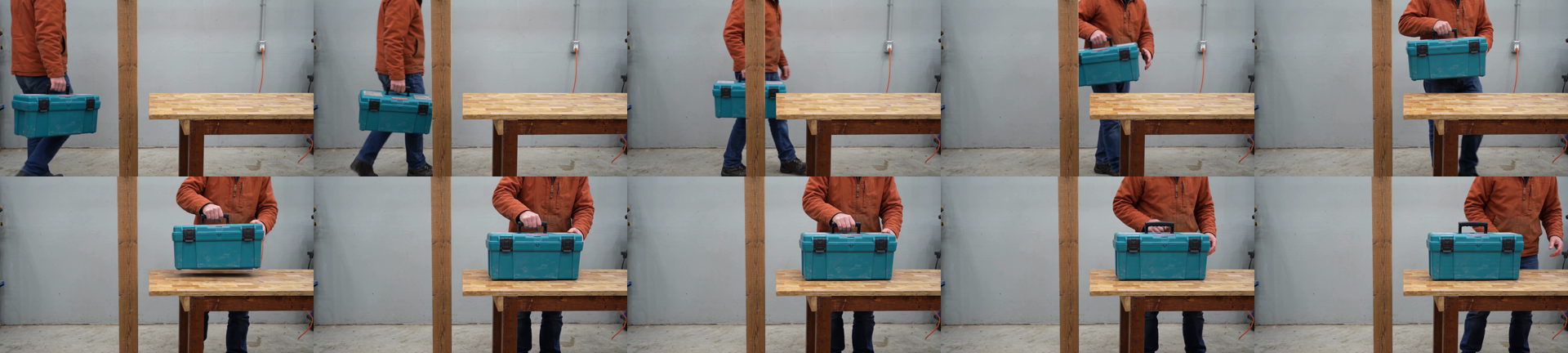
One continuous fixed wide shot in a workshop. An adult in a rust-orange jacket walks from left to right carrying exactly one closed teal toolbox in the right hand, passes behind a narrow wooden post, emerges with the same toolbox, places it on an empty workbench, releases the handle, and steps back with both hands empty. Keep the full body visible. Natural footsteps and one soft contact sound. No cuts, camera movement, extra people, or duplicate toolboxes.
Result: Partial pass.
Wan 3.0 kept the same teal toolbox before and after the person passed behind the post. The toolbox didn’t duplicate, and the subject placed it on the workbench: good signs for object permanence and ordered action. But the person’s head was cropped, so “full body visible” failed, and the subject stayed close to the bench instead of clearly stepping back with empty hands. The core action worked; the framing and final state didn’t fully.
Test 3: Dialogue, Lip Movement, and Prop Stability
Prompt
One continuous medium close-up in a pottery studio. A pottery teacher holds one terracotta bowl at chest height with both hands and says exactly once in natural English: “This bowl is ready. Let us paint it together.” After speaking, the teacher closes their mouth and gives a small smile. Keep the full face, both hands, and the bowl stable and visible. One clear voice, faint room ambience, no music, subtitles, logos, extra words, or additional objects.
Result: Strong dialogue accuracy; partial framing compliance.
An independent speech-to-text check returned “this bowl is ready let us paint it together” with about 96% confidence. Sampled frames show mouth movement during the line, then a closed-mouth smile. The bowl and both hands stayed stable, with no subtitles or logos. Once again the top of the head was cropped, so “full face” wasn’t fully met. We’d call the lip sync visually plausible in sampled frames, not a phoneme-level measurement.

What the Tests Tell Us, and What They Don’t
Wan 3.0 was strongest when a prompt asked for one clearly described subject and one dominant action. It held simple product geometry, kept a prop consistent through an occlusion, and delivered an exact short English line with matching facial motion.
Its main weakness was following every instruction. In two tests the core content was right, but framing or final-position constraints were only partly met. That’s a common production problem: a clip can look convincing and still fail a delivery requirement.
We ran one output per prompt and didn’t cherry-pick, which also means these results don’t measure variance.
Where Kling 4.0 May Fit
Kling 4.0’s official specs aim at control more than access. If these features perform as described once the full model launches:
10 keyframes could let you pin down what a scene looks like at specific moments across a 30-second clip.
15 references could help keep a character, product, or voice consistent across a series.
Video editing and extension (up to 5 input clips listed; 2-minute extension marked as coming soon) could reduce the need to regenerate from scratch.
4K output, 21:9, and stereo lip-sync would matter for big-screen ads and dialogue-heavy scenes.
If early-access results hold up under controlled testing, the useful Kling 4.0 vs Wan 3.0 questions won’t be “which demo looks more cinematic?” but:
Does the same person, product, or costume survive an occlusion and a camera move?
Does the model finish a multi-step action, including the final state?
Is the dialogue exact, and do the lips stop when the voice stops?
How often does a usable result arrive on the first attempt?
Which resolution, duration, reference, and API options can the tested account actually select?
What is the real cost per usable clip after failed generations?
Until Kling 4.0 can run under the same prompt, duration, aspect ratio, audio, and disclosure rules, a numerical Kling 4.0 vs Wan 3.0 score would be false precision.
Kling 4.0 vs Wan 3.0: Which One Should You Choose?
Here is how Kling 4.0 vs Wan 3.0 plays out by use case today:
Use case | Better pick today | Why |
|---|---|---|
Social clips you need this week | Wan 3.0 | Live now, up to 30 seconds at 1080p |
Training and explainer videos | Wan 3.0 | Document- and webpage-to-video |
Fixing part of a long clip | Wan 3.0 | Regenerate only a selected time range |
Developer integration | Wan 3.0 | Public API and per-second pricing |
Short drama and keyframed stories | Kling 4.0, once access is verified | Official 10-keyframe and 15-reference controls |
Big-screen product ads | Kling 4.0, once access is verified | Officially listed 4K output and 21:9, not yet tested |
Choose Wan 3.0 If You Need to Ship Now
Wan 3.0 is the practical pick when you need access, documentation, and an API today. It suits previsualization, product and social concepts, dialogue-led scenes, and workflows that start from images, video, audio, a document, or a webpage. Just plan to review framing and end states before delivery.
Choose Kling 4.0 If You Have Real Access and Can Evaluate It
Kling 4.0 is worth testing if your account actually offers the model and you care about keyframes, 4K, or reference control. Run it on your own prompts, and note the settings, generation time, and failed attempts so you can compare it fairly with what you use today. Also check the model selector to make sure you’re on 4.0, not Kling O3 or Kling 3.0.
How We’ll Run a Fair Head-to-Head Test
When Kling 4.0 becomes available on the same platform, we’ll rerun the three prompts above with matched settings. A fair update should:
Use text-to-video on both models
Use the same 16:9 aspect ratio and the closest common resolution
Turn on native audio for both
Use the same duration, or compare an identical five-second segment
Run at least three generations per prompt and publish every output
Score prompt compliance, subject stability, action completion, audio accuracy, lip timing, generation time, and cost
Disclose the platform, model variant, date, and any unavailable setting
Until then, the defensible conclusion is about access and workflow readiness, not an invented quality ranking.
Kling 4.0 vs Wan 3.0 FAQ
Is Kling 4.0 released?
Partly. Kling’s release notes say Kling 4.0 Flash opened to a limited group of users for early access on September 28, 2026, and the full model will officially launch in October 2026. No exact date has been given, and the model isn’t available to every account, API customer, or third-party studio yet.
What is the difference between Kling 4.0 and Kling 4.0 Flash?
According to Kling’s release notes, the full model makes 3–30 second clips at up to 4K with up to 10 keyframes, while Flash is built for faster, frequent creation and makes 3–20 second clips at 720p in 8-bit SDR, without listed keyframe control. We haven’t tested either version.
Can I use Kling 4.0 on JXP now?
Not as of September 30, 2026. JXP’s Kling 4.0 page listed Kling 3.0 and Kling O3 as available, but Kling 4.0 wasn’t connected yet.
Is Wan 3.0 generally available?
Yes. Alibaba Cloud says the Wan 3.0 Video API is generally available without an application, though availability can vary by region.
Is Wan 3.0 open source?
No. Wan 3.0 is offered as a hosted Model Studio service and API, and no Wan 3.0 model weights have been published.
Does Wan 3.0 support 4K?
No. Wan 3.0 outputs 480p, 720p, or 1080p. In this Kling 4.0 vs Wan 3.0 comparison, only Kling 4.0 officially lists 4K, and we haven’t tested it.
How much does a Wan 3.0 video cost?
On Alibaba Cloud Model Studio, list prices are $0.05 per second at 480p, $0.10 at 720p, and $0.20 at 1080p, so a 30-second 1080p clip costs $6.00. On JXP, each 5-second 720p Wan 3.0 Prime generation in our tests cost 20 credits.
Can Wan 3.0 turn a PDF or slide deck into a video?
Yes. Wan 3.0 accepts one supported document, such as a PDF, PPT, DOC, XLS, or Markdown file, or a public webpage as a reference in its file/link workflow.
Which is better, Kling 4.0 or Wan 3.0?
For immediate use, Wan 3.0 is the better verified choice, because we could run it and inspect the outputs. Kling 4.0 may turn out stronger for some creative tasks, but we can’t responsibly rank its output quality until it’s accessible under a controlled, matched test.
Final Verdict
The most important Kling 4.0 vs Wan 3.0 difference today isn’t a cinematic adjective. It’s whether the model can enter your workflow.
Wan 3.0 is available, documented, and able to produce usable short audiovisual scenes, though our tests show that precise framing and final-state instructions still need review. Kling 4.0 is a real early-access release with ambitious official specs, but it wasn’t available for an equivalent JXP test. Treat it as a model to evaluate, not a winner by announcement.