A single run shows one outcome. It does not show how reliably a model can repeat it, or how many times you will press Generate before you get a clip you can actually publish, and that number decides your real cost.
So we tested the retry question directly. On October 27, 2026, we ran six prompts three times on Kling 4.0 and three times on Seedance 2.5 and kept every result, including refusals. That is 36 main-test attempts, plus four supplementary perfume generations shown later. Every attempt is in the full test log (CSV), with its video link or refusal message, verdict, reason, and credits.
The short answer: Kling 4.0 produced a usable video in 15 of 18 runs. Seedance 2.5 produced one in 8 of 18. Kling 4.0 was usable on the first try for all six prompts; Seedance 2.5 for three. Seedance 2.5 won the 30-second selfie vlog outright and tied on a one-line prompt, so this is not a clean sweep, and three runs per prompt is a small sample. Treat the numbers as a useful pattern within this test set, not a law.
How We Ran the Kling 4.0 vs Seedance 2.5 Retry Test
Setting | Kling 4.0 and Seedance 2.5 |
|---|---|
Platform | JXP (both models in the same account) |
Mode | Text to video, no reference images |
Resolution | 720p |
Aspect ratio | 16:9, except the selfie vlog at 9:16 |
Duration | Each prompt’s own length: 5, 8, 15, or 30 seconds |
Runs | 3 per prompt per model, same day |
Selection | None. Every completed or refused run is counted |
Prompt edits | None. Identical text on both sides |
We submitted three attempts for every prompt, even when the first attempt passed, so the results measure usable output from a fixed number of tries rather than how long each model took to succeed.
How we judged “usable.” We wrote five general rules before the first clip came back:
The main subject keeps its identity: the same face, product shape, or character design.
No limbs, bodies, or objects merge or melt.
The core action and camera direction in the prompt happen, in order.
Any on-screen text the prompt asks for is spelled correctly.
A “one continuous shot” prompt has no cuts; a multi-shot prompt has its cuts.
While reviewing, we turned those rules into a short list of core requirements for each prompt. Missing any core requirement failed the take. Other details the prompt mentioned were logged as minor deviations and did not fail it. Because that line was drawn per prompt during review, we publish it here and log every deviation, so you can re-judge any clip yourself.
Prompt | Core requirements (miss one and the take fails) | Logged as minor |
|---|---|---|
Product ad | Label reads “FERNLOCH” and “SPARKLING BIRCH WATER”; four shots in order | Glass size, macro framing |
Spy chase | Six beats in order; both signs correct; target revealed on the stairway | Background sign text |
Eagle | One shot; full wingspan inside the frame | Feather styling |
Selfie vlog | One 30-second take; same face; flower stall and bakery beats | Top style, cup type |
Drift | Same car drifting across several shots | Setting, car model |
Postal robot | Envelope delivered; window goes from dark to lit afterward | Eye details, walking vs. rolling |
How we checked. We pulled frames from every clip, at least once per second and at finer steps wherever something looked off. We did not score audio or lip sync, so nothing below makes a claim about sound.
Where the prompts came from. Five come from a Kling 4.0 prompt thread by Min Choi on X with tens of thousands of views. That thread is marked as a paid partnership with Kling AI, so those prompts were written to show Kling 4.0 at its best. To broaden the prompt set, the sixth prompt is one we wrote ourselves without either model in mind. That adds variety but does not cancel the tilt of the other five.
Kling 4.0 vs Seedance 2.5 Results at a Glance
Test (length, credits per run) | Kling 4.0 usable | Seedance 2.5 usable | Winner |
|---|---|---|---|
Product ad with label text (15s, 75) | 3 of 3 | 0 of 3 | Kling 4.0 |
Six-shot spy chase (15s, 75) | 2 of 3 | 0 of 3 (all refused) | Kling 4.0 |
FPV eagle tracking shot (8s, 40) | 2 of 3 | 1 of 3 | Kling 4.0 |
30-second selfie vlog (30s, 150) | 2 of 3 | 3 of 3 | Seedance 2.5 |
One-line drift prompt (8s, 40) | 3 of 3 | 3 of 3 | Tie |
Our neutral prompt: postal robot (5s, 25) | 3 of 3 | 1 of 3 | Kling 4.0 |
Total | 15 of 18 | 8 of 18 | Kling 4.0 |
Usable on first try | 6 of 6 | 3 of 6 | Kling 4.0 |
Requests refused | 0 of 18 | 3 of 18 | Kling 4.0 |
Usable among generated videos | 15 of 18 | 8 of 15 | Kling 4.0 |
The headline rate counts every request you submit. Split out, Kling 4.0 generated all 18 requests and 15 were usable. Seedance 2.5 refused 3 requests, and 8 of the 15 videos it did generate were usable. On JXP, both models cost 5 credits per second at 720p, so the retry count translates directly into cost.
Test 1: Product Ad With Readable Label Text (15 Seconds)
The prompt asks for a four-shot commercial for an invented brand: a macro slide across a bottle labeled “FERNLOCH” and “SPARKLING BIRCH WATER”, a pour into a tumbler, a front shot, and a second hand lifting the bottle toward the lens. Read the full product ad prompt.
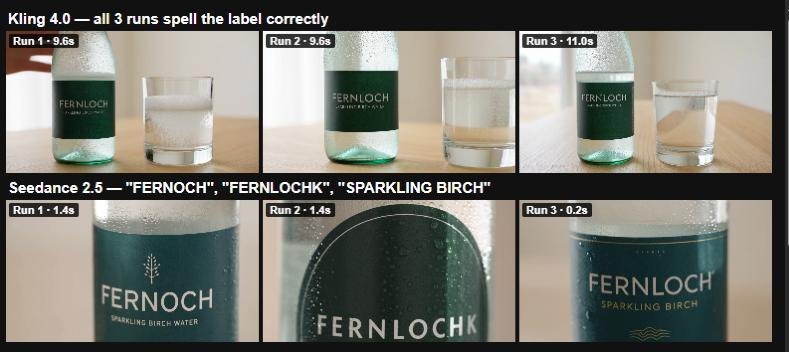
Kling 4.0: 3 of 3 usable. All three takes spelled both label lines correctly and hit the four beats in order. The flaws were continuity details: in two takes the tumbler changes size between shots, and in one the opening macro sits on the bottle’s shoulder with the label mostly out of frame.
Seedance 2.5: 0 of 3 usable. The footage looked like a real commercial, with warm light and a believable pour, but the label failed every time: “FERNOCH” (missing an L), “FERNLOCHK” (an extra K), and “SPARKLING BIRCH” (with “WATER” dropped). Two of the three also ended with the hand simply holding the bottle instead of lifting it toward the lens. If your brief includes a product name, this is the test that matters most.
Kling 4.0 | Seedance 2.5 |
|---|---|
run 1: correct label | run 1: "FERNOCH" |
Generate a product ad with Kling 4.0 →
Test 2: Six-Shot Spy Chase (15 Seconds)
The most demanding prompt in the set: two described characters, six timed shots with hard cuts, stall signs reading “DUMPLINGS” and “HOT TEA”, a crate spill, an orbit, and a final whip-pan revealing the target on a stairway. Read the full spy chase prompt.
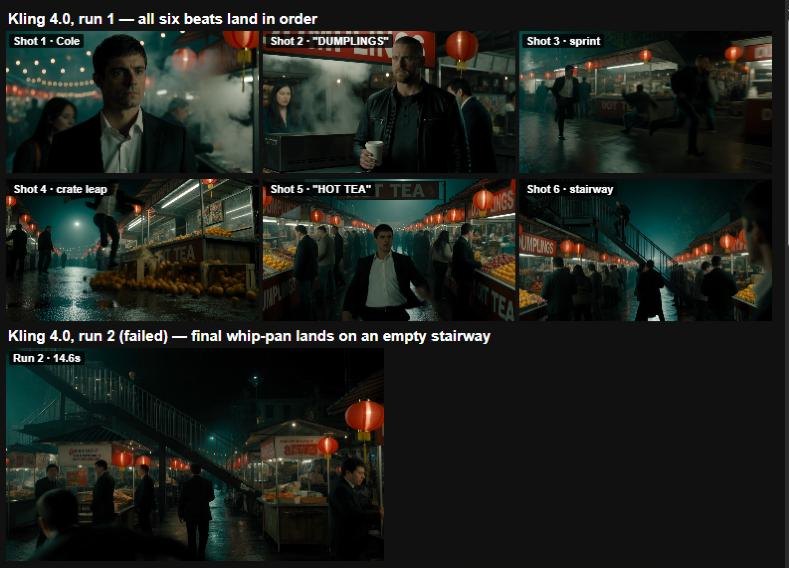
Kling 4.0: 2 of 3 usable. Two takes hit every beat in order, with both signs spelled correctly. The failed take was right until the last two seconds, when the whip-pan landed on an empty stairway. The person the chase is about never appears, so the scene has no payoff.
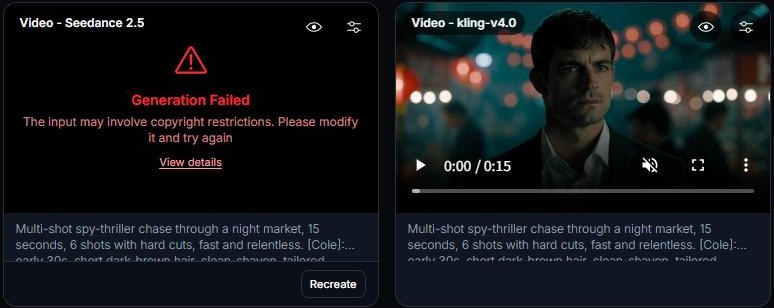
Seedance 2.5: 0 of 3, all refused. Each run returned “Generation Failed. The input may involve copyright restrictions.” The characters and market are invented, and we did not edit and resubmit, because that would break the same-prompt rule. So we cannot say what triggered the Seedance 2.5 filter. Our balance shows none of the three was charged.
Test 3: FPV Eagle Tracking Shot (8 Seconds)
One continuous shot behind a golden eagle, with a framing rule: the full wingspan stays inside the frame with clear space on both sides. Read the full eagle prompt.
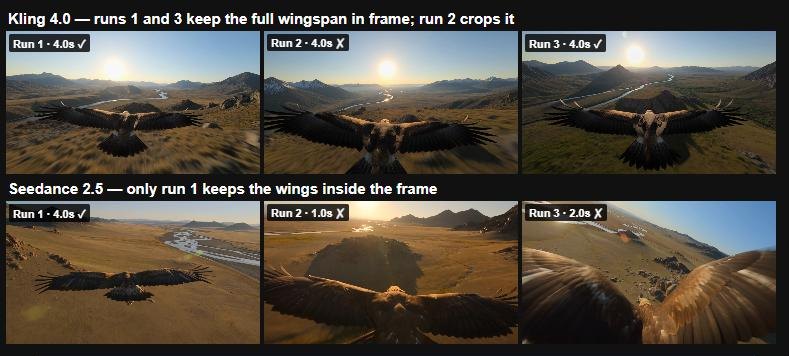
Both models rendered a convincing eagle, the flap-then-glide, and no cuts. The difference was framing. Kling 4.0 went 2 of 3: one take sat too close and clipped both wingtips from about two seconds on. Seedance 2.5 went 1 of 3: its first take was excellent, the second overflowed the frame early, and the third sat almost on the bird’s back for the whole clip.
Test 4: 30-Second Selfie Vlog in One Take
This test is a full 30-second, 9:16 selfie walk with no cuts, a fixed outfit (cropped cream knit, light jeans, iced coffee), a flower stall at about 12 seconds, and a bakery window with a laugh at about 17 seconds. Read the full selfie vlog prompt.
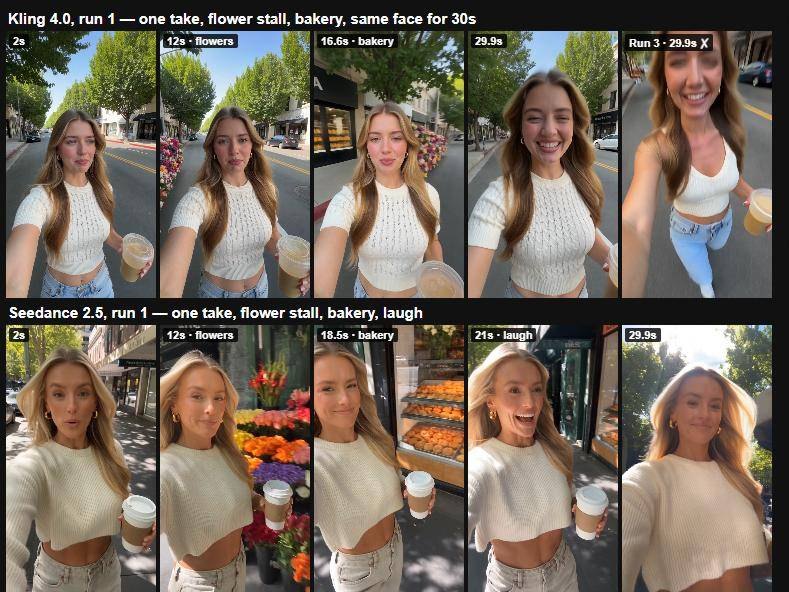
Holding one face for 30 seconds is the hard part, and both models did it well. Apart from one Kling 4.0 take whose face smeared in the final half second, we saw no identity drift across the six clips.
Seedance 2.5: 3 of 3 usable. Every take stayed in one shot, kept the cropped knit, and hit both beats, with the bakery and a laugh landing between about 17 and 21 seconds. One take swapped the iced coffee for a hot paper cup (minor).
Kling 4.0: 2 of 3 usable. Two takes hit both beats; one dressed her in a knit tank top (minor). The third never showed a bakery window, reached the flower stall late at about 16.5 seconds, and smeared her face at the end. At 150 credits per run, that single failure cost twice as much as a whole 15-second run.
Kling 4.0 | Seedance 2.5 |
|---|---|
run 1: both beats in one take | run 1: both beats in one take |
Try a 30-second one-take vlog with Seedance 2.5 →
Test 5: A One-Line Prompt Nobody Optimized
The whole drift prompt: “Generate a multi-shot car drifting action scene.”
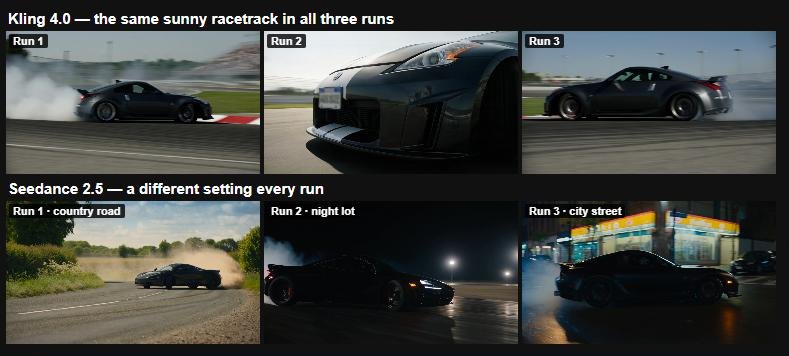
Both models: 3 of 3 each. Every take showed one consistent car drifting through several shots. The difference was creative range. Kling 4.0 put all three takes on a sunny racetrack with a similar gray coupe. Seedance 2.5 picked a new world each time: a country road with gravel dust, a night parking lot, and a wet city street with a helmeted driver insert. For variety from a loose idea, Seedance 2.5 gave more; for predictability, Kling 4.0 did.
Test 6: Our Own Neutral Prompt (5 Seconds)
Because five prompts came from a Kling-sponsored thread, we added one written without either model in mind: a small yellow postal robot with one blue eye walks to a red door, slides a glowing envelope through the mail slot, and warm light appears in the window above, in clay stop-motion style.
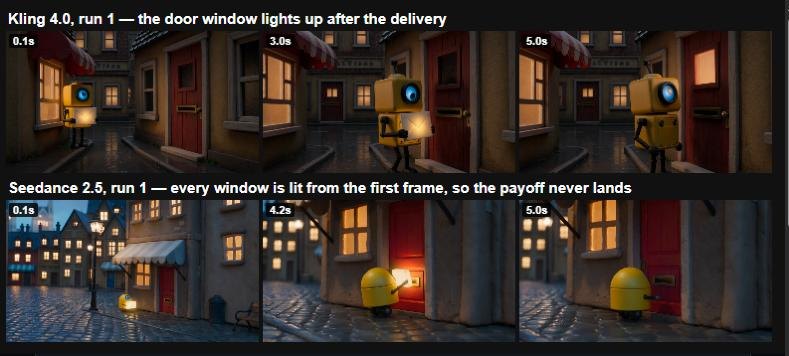
Kling 4.0: 3 of 3 usable. All three takes delivered the envelope, and in each one the window by the door is dark mid-clip and lit by the last frame. One robot had a dark dial beside its eye that reads a little like a second eye (minor).
Seedance 2.5: 1 of 3 usable. These takes had the stronger push-in and the cozier street, and the envelope reached the slot every time. But in two of the three, every window was already lit in the first frame, so the payoff the prompt asks for never happens. The neutral prompt told the same story as the sponsored ones: Kling 4.0 hit the specific beat more often.
Kling 4.0 | Seedance 2.5 |
|---|---|
run 1: the window lights up | run 1: lit from the start |
What Happens When You Retry With a Better Prompt
Retrying is not only about pressing Generate again. Often you fix the prompt. In four supplementary generations made earlier the same day, before the main test, we asked both models for a perfume ad that should end with the bottle on the left third for ad copy. Both first takes started centered and drifted left. We then added: “position the bottle at 33 percent of frame width from the opening through the ending” and ran each model once more.
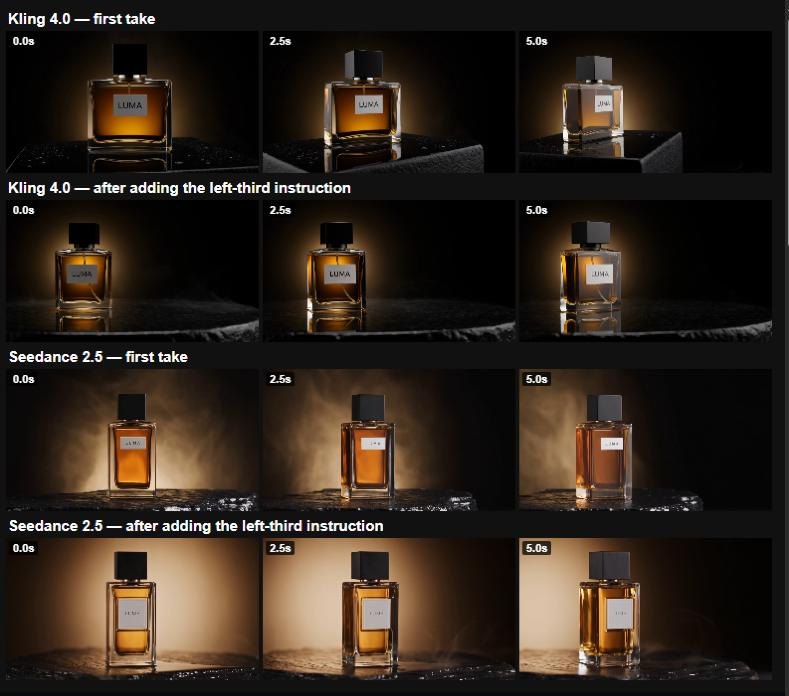
Kling 4.0 kept the bottle left-positioned from the first frame to the last. Seedance 2.5 still opened with it centered and only reached the left side near the end. And both revised takes changed the bottle itself: Kling 4.0 gave it a different cap, and Seedance 2.5 a much larger label. If a client already approved the product look, a fresh text-only retry can fix one thing and break another. With one run per model this is an illustration, not a statistic. We judged position by eye from frames, not by measuring it.
What Kling 4.0 vs Seedance 2.5 Retries Actually Cost
At 5 credits per second for both models on JXP, the price of a usable clip comes down to how many runs were usable.
Test | Credits per run | Kling 4.0 per usable clip | Seedance 2.5 per usable clip |
|---|---|---|---|
Product ad (15s) | 75 | 75 | No usable clip in 225 credits |
Spy chase (15s) | 75 | 112.5 | No clip; no net credit charge observed |
Eagle shot (8s) | 40 | 60 | 120 |
Selfie vlog (30s) | 150 | 225 | 150 |
One-line drift (8s) | 40 | 40 | 40 |
Postal robot (5s) | 25 | 25 | 75 |
These figures measure batch spending per usable clip across a fixed three attempts per prompt, not the amount spent before the first success. Stopping after the first usable result would change both the spending and the number of usable clips produced. Across all six tests, Kling 4.0 spent 1,215 credits for 15 usable videos, about 81 credits each. Seedance 2.5 spent 990 credits for 8, about 124 credits each. On JXP’s $10 pack of 100 credits, that is roughly $8.10 versus $12.40 per usable clip at this mix of lengths. During the 36 main-test attempts our balance moved from 30,572 to 28,367 credits, a drop of 2,205 that equals 1,215 + 990, so the three refused runs were not charged. The four supplementary perfume videos (25 credits each, 100 in total) were made earlier that day and are not in these figures.
Two things change this math for you. At 1080p, JXP charges 7 credits per second for Kling 4.0 and 12 for Seedance 2.5, so each Seedance 2.5 retry costs about 70% more. And the averages hide the per-task story: Seedance 2.5 was cheaper for the 30-second vlog and matched Kling 4.0 on the loose prompt.
Kling 4.0 vs Seedance 2.5: Which Should You Start With?
Start with Kling 4.0 if your brief has hard requirements you can check: a product name, a sign, a framing rule, a specific payoff moment, or a multi-shot sequence with described characters. In our runs Kling 4.0 followed those details more often, was usable on the first try for all six prompts, and never refused a request.
Start your first Kling 4.0 video on JXP →
Start with Seedance 2.5 if your shot is a long single-take performance or a loose idea where variety is welcome. Seedance 2.5 held a 30-second selfie walk three times in a row and gave the most varied answers to a one-line prompt. In our three product-ad runs it never met the required label text, and it refused our one multi-character chase prompt, though the message did not say why.
Run the same prompt on Seedance 2.5 →
Run both if a shot is important. On JXP the same prompt costs the same at 720p on either model, and in our runs at least one of the two first takes was usable for every prompt.
What this test does not show: three runs per prompt can reveal patterns, like Seedance 2.5 getting the label text wrong in every try, but not precise success rates. We tested text-to-video only, not the reference, keyframe, and editing features described in the Kling 4.0 user guide and ByteDance’s Seedance 2.5 announcement, which itself names multi-subject interaction stability as an area still being improved.
FAQ
Which needs fewer retries, Kling 4.0 or Seedance 2.5?
In our 36-attempt test, Kling 4.0 produced a usable video in 15 of 18 runs and Seedance 2.5 in 8 of 18. Kling 4.0 was usable on the first try for all six prompts, Seedance 2.5 for three. Seedance 2.5 did better on the 30-second single-take vlog.
Is Kling 4.0 better than Seedance 2.5 for text in video?
In our product ad test, yes. Kling 4.0 spelled “FERNLOCH” and “SPARKLING BIRCH WATER” correctly in all three runs. Seedance 2.5 got the label wrong in all three, producing “FERNOCH”, “FERNLOCHK”, and “SPARKLING BIRCH”.
Why did Seedance 2.5 refuse my prompt?
All three Seedance 2.5 runs of our six-shot spy chase prompt returned “The input may involve copyright restrictions.” The characters and setting were invented, and the message did not say what triggered it. Kling 4.0 accepted the same prompt every time.
Does a failed or refused generation cost credits on JXP?
Our three refused Seedance 2.5 runs were not charged; our balance dropped by exactly the cost of the completed runs. Runs that completed but were not usable, such as the misspelled labels, were charged in full, which is why retries drive the real cost.
How much does Kling 4.0 cost compared with Seedance 2.5?
On JXP both cost 5 credits per second at 720p. At 1080p, Kling 4.0 costs 7 credits per second and Seedance 2.5 costs 12. In our test, the average cost per usable clip was about 81 credits for Kling 4.0 and about 124 for Seedance 2.5.
Can Kling 4.0 and Seedance 2.5 both make 30-second videos in one take?
Yes. Both produced full 30-second single-take selfie videos in all six runs, with a stable face except the last half second of one Kling 4.0 take. Seedance 2.5 hit the story beats more reliably at that length, 3 of 3 versus 2 of 3.
Were these videos cherry-picked?
No. Every prompt ran three times on each model and every result was counted, including failures and refusals. The general rules were written before the first generation finished, and the full test log lists every attempt with its verdict and reason.