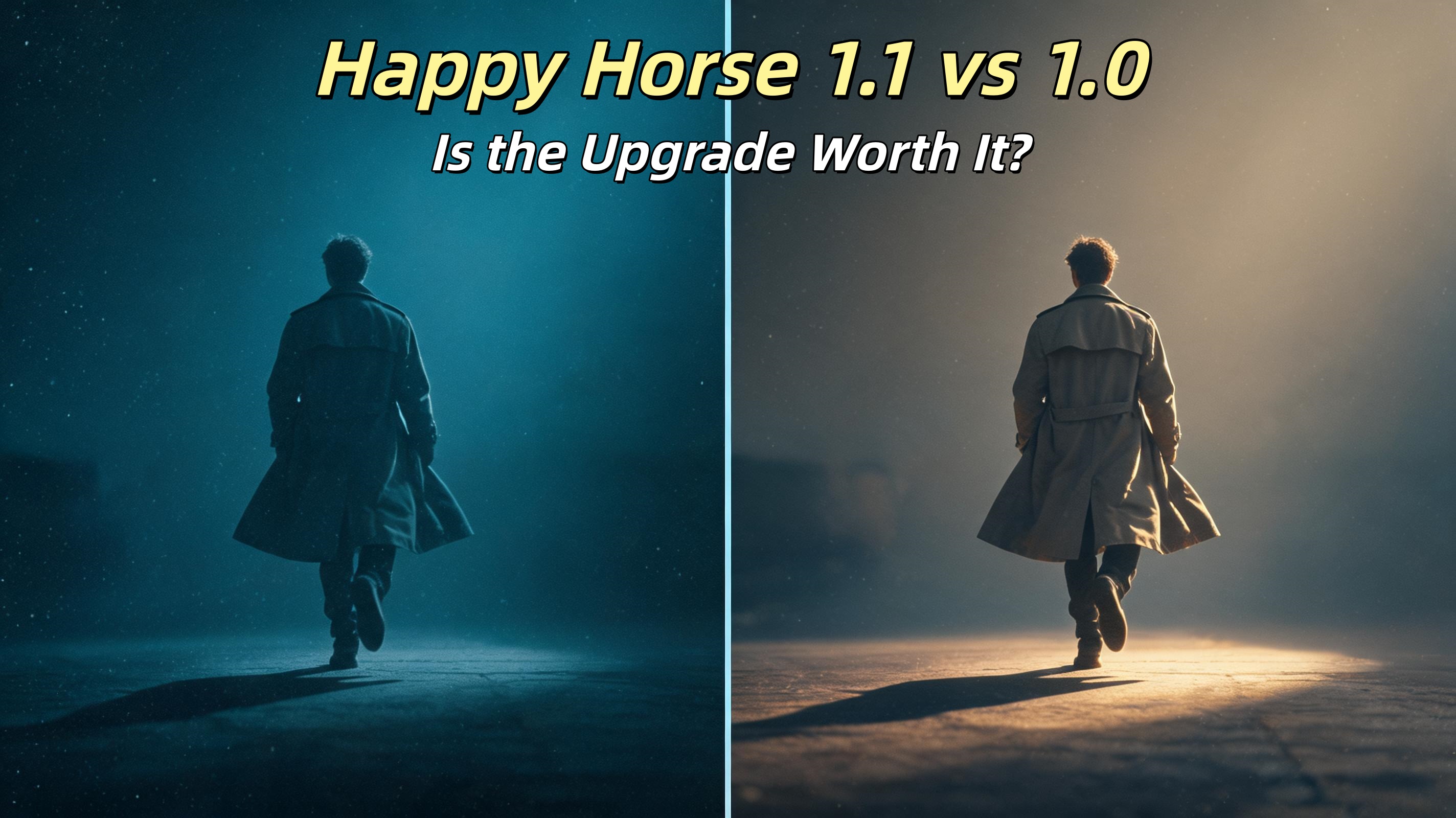
When Happy Horse 1.0 quietly climbed to the top of the Artificial Analysis Video Arena in April 2026, it turned an anonymous “mystery model” into one of the most talked-about AI video generators of the year. Now Alibaba’s ATH AI Innovation Unit has shipped a refined release — and the question every creator is asking is simple: in the Happy Horse 1.1 vs 1.0 comparison, is the upgrade actually worth your time and credits?
To answer that, we worked through the official side-by-side comparison material across four production categories — short drama, e-commerce product video, brand marketing, and character CG — and looked closely at where Happy Horse 1.1 visibly pulls ahead of the previous version. Here is what stands out.
Verdict: Happy Horse 1.1 is not a ground-up rebuild. It is a targeted, production-driven refinement of Happy Horse 1.0. For short dramas, e-commerce ads, brand marketing, and character-driven CG, the gains in motion, consistency, instruction-following, visual quality, and audio make Happy Horse 1.1 a clear step up. For quick single-shot social ideation, 1.0 already did the job — but there is little reason to stay on the older version once you have access to Happy Horse 1.1.
Try Happy Horse 1.1 free and compare the output as you read →
What Is Happy Horse 1.1?
Happy Horse 1.1 is the first major refinement of the Happy Horse AI video model (sometimes written HappyHorse), which launched on April 27, 2026. Since that release, Happy Horse 1.0 was adopted across real content-production pipelines — short drama creation, e-commerce advertising, brand marketing, and CG. Happy Horse 1.1 is built directly on that production feedback: the team identified the five areas that most often caused re-renders under deadline pressure and targeted each one.
Every capability in Happy Horse 1.1 — text-to-video (T2V), image-to-video (I2V), and reference-to-video (R2V) — is also exposed through the API, so the upgrade is available to both creators and developers simultaneously. Think of it less like buying a new camera and more like a firmware update for one you already own: the same sensor, but sharper processing exactly in the moments that used to trip it up. In short, Happy Horse 1.1 keeps the benchmark strengths of the original while turning them into dependable, repeatable production quality.
How We Compared the Two Versions
This Happy Horse 1.1 vs 1.0 comparison is based on the official side-by-side upgrade material, which pairs the same prompt run on both versions across these areas:
Categories covered: action / fight scenes, product livestream promos, short drama dialogue, and CG character close-ups
What we looked at: motion smoothness, subject identity stability across frames, prompt adherence, skin and texture rendering, and audio-visual sync
Reference-image cases: R2V examples using 2–3 reference images, identical across both versions
We do not have access to internal benchmark numbers from Alibaba’s ATH team, and the observations below are qualitative — they describe the differences visible in the official Happy Horse 1.1 and 1.0 comparison clips, not a private scored benchmark. If you want hard numbers for your own use case, the most reliable path is running your own prompts on both versions.
Happy Horse 1.1 vs 1.0: The Five Biggest Upgrades
1. Stronger Motion Expressiveness
What changed: Happy Horse 1.1 improves motion modeling and temporal consistency, producing smoother actions and stronger kinetic tension in complex action sequences.
HappyHorse 1.1 | HappyHorse 1.0 |
|---|---|
What we observed: In the fight-scene example, the protagonist counters an opponent’s punch using their own momentum, with body rotation and centrifugal force that follow a clear cause-and-effect chain. Where Happy Horse 1.0 could let motion drift or stall mid-action, Happy Horse 1.1 keeps body rotation, momentum transfer, and impact timing physically grounded throughout — no floating, no sudden stops without a cause. The gap is most visible in shots with more than one overlapping motion, exactly where 1.0 was most likely to look sluggish or incoherent.
Who benefits most: Action shorts, dynamic social content, cinematic sequences with continuous camera movement.
2. Better Subject Consistency and Multi-Reference Fusion
What changed: Happy Horse 1.1 strengthens how the model reads and fuses multiple reference images in R2V tasks, keeping subjects closer to reference assets across the full clip.
HappyHorse 1.1 | HappyHorse 1.0 |
|---|---|
What we observed: In the product-livestream example using two reference images (skincare and a lipstick), Happy Horse 1.1 holds the product details and brand elements steady that Happy Horse 1.0 could soften or quietly reinvent toward the middle of a clip. In a two-character narrative example — a princess confronted by a dragon-man — Happy Horse 1.1 maintains each character’s costume and facial identity without blending them across the shot.
Who benefits most: E-commerce product video, storyboard-driven production, multi-character narrative content.
3. Improved Instruction Following
What changed: Happy Horse 1.1 improves long-context semantic understanding, scene planning, and character-relationship modeling, producing more on-direction results under complex multi-scene, multi-character prompts.
What we observed: In the minimalist living-room example, two characters move through a quiet, emotional exchange with the restrained pacing and short-drama look the prompt called for, instead of the looser staging 1.0 sometimes produced. The biggest difference shows up in prompts that define a relationship dynamic: Happy Horse 1.1 reads “character A is confronting character B” as a motion cue, while 1.0 occasionally treated such lines as purely descriptive.
HappyHorse 1.1 | HappyHorse 1.0 |
|---|---|
Prompt tip: When writing R2V prompts that describe interaction between references, name the relationship directly — “[image 1] and [image 2] start fighting” works better than “two characters engage in combat.” Keep prompts focused; over-constrained prompts can suppress the motion engine even in Happy Horse 1.1.
Who benefits most: Short drama, multi-scene ad scripts, storyboard execution.
4. Higher Visual Quality and More Realistic Detail
What changed: Happy Horse 1.1 refines character rendering, particularly facial detail generation. The over-sharpening, oily highlights, and smeared skin textures that could appear in Happy Horse 1.0 close-ups are reduced.
HappyHorse 1.1 | HappyHorse 1.0 |
|---|---|
What we observed: In the cinematic classroom example, Happy Horse 1.1 renders skin with more natural texture and pore-level detail while warm afternoon sunlight rakes across the desks and fine dust drifts through the light — where 1.0 could look over-sharpened or glossy. Close-up character shots gain expressiveness, and Happy Horse 1.1 shows a steadier grasp of professional camera language such as shot-reverse-shot and tracking shots, so multi-shot transitions and pacing feel more coherent.
Limitation to note: In very high-motion close-ups (fast head turns, rapid expression changes), both versions can still produce mild facial warping. Happy Horse 1.1 handles these better than 1.0, but the issue is not fully eliminated.
Who benefits most: Short drama, advertising with hero talent shots, brand content where faces fill the frame.
5. Upgraded Audio Expression
What changed: Happy Horse 1.1 improves audio-visual synchronization and prompt-based audio interpretation. Dialogue delivery pace and tone shift to match scene context, and sound-related prompt descriptions are followed more reliably.
HappyHorse 1.1 | HappyHorse 1.0 |
|---|---|
What we observed: In the kitchen-at-dusk example, the soft simmer of a pot, the rhythm of a chopping board, and the restrained dialogue line up with the on-screen action — the chop of a knife lands with the cutting motion rather than slightly ahead of or behind it, as could happen in 1.0. Happy Horse 1.1 also keeps ambient layers tracking the picture more consistently and introduces fewer irrelevant audio artifacts not referenced in the prompt.
Who benefits most: Short drama, lifestyle brand content, any clip where ambient sound is part of the narrative.
Happy Horse 1.1 vs 1.0: Quick Comparison Table
Capability | Happy Horse 1.0 | Happy Horse 1.1 |
|---|---|---|
Motion expressiveness | Good, but drifts in fast action | Smoother, physically grounded |
Subject consistency | Solid single-subject | Stronger multi-reference fusion |
Instruction following | Reliable on simple prompts | Better on complex multi-character prompts |
Visual quality | Can over-sharpen skin | More natural skin and richer detail |
Audio expression | Synced but occasionally offset | Tighter AV sync, fewer artifacts |
Generation modes | T2V / I2V / R2V | T2V / I2V / R2V (all upgraded) |
API support | Yes | Yes — full capability parity |
High-motion close-up faces | Some warping | Improved but not fully resolved |
Happy Horse 1.1 vs Competitors
vs Seedance 2.0: Happy Horse 1.0 already traded the top spot with Seedance 2.0 on blind-preference leaderboards. Happy Horse 1.1 pushes further on motion and multi-reference consistency — areas where Seedance 2.0 has historically been strong. For e-commerce R2V specifically, Happy Horse 1.1’s improved reference fusion gives it an edge.
vs Runway Gen-4.5: Runway Gen-4.5 maintains an advantage in creative stylization and fine-grained camera control. Happy Horse 1.1 closes the gap on photorealistic character rendering and is more cost-accessible for high-volume production workflows.
A note on these comparisons: We did not run direct, controlled side-by-side tests against Seedance 2.0 or Runway Gen-4.5 here. These competitor notes are based on published leaderboard data and prior independent testing, not on our own head-to-head runs — so treat them as directional, and test on your own prompts before committing.
Happy Horse 1.1 in Real Production Scenarios
Reading the Happy Horse 1.1 vs 1.0 differences through the lens of actual jobs makes the value concrete. For short drama creation, the motion, instruction-following, and audio gains keep multi-shot dialogue scenes coherent and emotionally readable, so fewer takes get thrown out mid-production. For e-commerce advertising, the reference-to-video consistency in Happy Horse 1.1 protects product labels and brand color values that Happy Horse 1.0 could soften by the mid-clip. For brand marketing and character CG, the higher visual fidelity and steadier camera language push Happy Horse 1.1 output closer to broadcast-ready without extra compositing passes. Across every category, Happy Horse 1.1 reduces the re-renders that Happy Horse 1.0 occasionally forced — and on a real production schedule, that is where the upgrade pays for itself.
Should You Upgrade to Happy Horse 1.1?
Upgrade if you make: short dramas, character-driven stories, e-commerce product video, brand and advertising content. These are the workflows where the motion, consistency, visual-quality, and audio improvements compound — and where Happy Horse 1.0’s weaker spots were most likely to force re-renders.
Less urgency if: you only generate quick single-shot social clips for fast ideation. Happy Horse 1.0 was already capable there. Even so, because all Happy Horse 1.1 capabilities ship through the API with full parity, there is little practical reason to stay on the older version once you have access.
On credits: if you are working within a tight credits budget, reserve Happy Horse 1.1 for final delivery scenes where quality is non-negotiable, and use 1.0 for early-stage concepting and rough cuts.
Practical workflow: rough out concepts in 1.0 for speed, then move final scenes into Happy Horse 1.1 for production-grade motion, consistency, and audio. Used this way, the Happy Horse 1.1 vs 1.0 question stops being “either/or” and becomes “use the upgrade where quality matters most.”
Try Happy Horse 1.1 free — generate your first clip →
FAQ
What is new in Happy Horse 1.1 compared to 1.0?
Happy Horse 1.1 upgrades five areas: stronger motion expressiveness, better subject consistency and multi-reference fusion, improved instruction following, higher visual quality with more natural skin rendering, and upgraded audio with tighter audio-visual synchronization.
Is Happy Horse 1.1 better than Happy Horse 1.0?
For most production work — short dramas, e-commerce ads, brand content, and CG — yes. Happy Horse 1.1 keeps the benchmark strengths of Happy Horse 1.0 while reducing the motion drift, consistency gaps, and skin-rendering issues that surfaced in real-world workflows. High-motion close-up facial warping improved in Happy Horse 1.1 but is not fully resolved — expect occasional artifacts in rapid head turns or expression changes.
Does Happy Horse 1.1 support text-to-video, image-to-video, and reference-to-video?
Yes. Happy Horse 1.1 supports T2V, I2V, and R2V, plus multi-image reference input, flexible aspect ratios, and 720p/1080p output — all available through the API.
Is Happy Horse 1.1 available via API?
Yes. Every Happy Horse 1.1 capability is exposed through the API with full parity to the web experience, giving developers and enterprise customers a complete integration path.
What prompt format works best with Happy Horse 1.1?
Keep prompts focused and concise. For R2V, name interaction relationships directly — “[image 1] and [image 2] start fighting” outperforms generic descriptions like “two characters engage in combat.” Avoid stacking too many constraints; over-specified prompts can suppress the motion engine in Happy Horse 1.1 and produce flatter results.
Happy Horse 1.1 vs Seedance 2.0 — which should I choose?
Happy Horse 1.1 extends its lead on motion and multi-reference R2V over Seedance 2.0, building on a Happy Horse 1.0 that already competed at the top of blind-preference leaderboards. For e-commerce video and short drama, Happy Horse 1.1 is worth testing first — and running your own prompts on both models is the surest way to decide.
Happy Horse 1.1 vs Runway Gen-4.5 — which is better for brand content?
Runway Gen-4.5 leads on stylization and camera control. Happy Horse 1.1 is stronger on photorealistic character rendering and better suited to high-volume production. For brand content with a naturalistic visual direction, Happy Horse 1.1 is the more cost-efficient choice.