If you’ve spent any time comparing AI video models this month, you’ve seen a dozen “Wan 3.0 vs MiniMax H3” posts — and a fair number of them get the basic facts wrong, in both directions. Some describe Wan as “Alibaba’s open-weight video line you can self-host,” which overstates it. Others still claim Wan 3.0 has no published license at all, which is now out of date: Alibaba has stood up an official Apache-2.0 GitHub repository for Wan 3.0. What that repository does not contain is any downloadable model weights — it’s documentation and licensing, not a self-hostable checkpoint. Businesses should be precise about that distinction: an open-source repository and independently downloadable model weights are not the same thing, and today only one of them exists for Wan 3.0. Get details like that wrong, and the rest of the comparison — resolution, duration, prompt adherence — doesn’t matter much, because you were never actually comparing the products your business would be built on.
Most Wan 3.0 vs MiniMax H3 comparisons start with resolution, maximum duration, prompt adherence, and image quality. Those differences matter, but they are not necessarily the differences that determine whether a video model can support a real business.
A creator may care about which model produces the most impressive first generation. A business has a harder question:
Which model can produce acceptable results repeatedly, at a predictable cost, inside a workflow that still works when output scales?
That changes the comparison.
For an agency, AI SaaS product, e-commerce team, automated content operation, or commercial video studio, the important metrics include retry rate, revision cost, API availability, reference consistency, deployment options, licensing, throughput, and how much human editing is required before a clip can actually be delivered.
That is where Wan 3.0 and MiniMax H3 become very different products.
Quick verdict: Wan 3.0 currently makes the stronger case for businesses that want an API-first production system with longer generations, broad input support, and less infrastructure to manage. MiniMax H3 becomes particularly interesting for technical teams that value open weights, pipeline control, multimodal reference workflows, and the option to move part of generation onto their own infrastructure — provided its licensing and territorial requirements fit the business.
The winner therefore depends less on benchmark quality and more on what the business is actually selling.
Wan 3.0 vs MiniMax H3: The Business-Critical Differences
A normal specification table tells only part of the story. For commercial production, each specification has an operational consequence.
Business Factor | Wan 3.0 | MiniMax H3 | Why It Matters |
|---|---|---|---|
Maximum duration | Up to 30 seconds | Up to 15 seconds | Longer generations may reduce stitching and editing |
Output resolution | Up to 1080P | Up to 2K through API workflow | Higher resolution can reduce finishing work |
Native audio | Yes | Yes, stereo audio | May remove a separate sound-generation step |
Multimodal references | Up to 20 assets, including files and links | Images, videos and audio | Determines how much source material enters one workflow |
Documents/web input | Supported | Not the primary H3 reference workflow | Useful for turning briefs and documents into video |
First/last frame | Supported | Supported through FL2VA | Important for controlled transitions |
Video editing | Supported | Multimodal regeneration/editing workflows | Affects revision cost |
Hosted API | Yes | Yes | Required for most SaaS integrations |
Open weights | Apache-2.0 GitHub repo exists, but no downloadable weights published | Yes | Gives H3 another deployment path |
Local deployment | Not currently possible — no weights to deploy | Officially supported | Can change infrastructure economics |
Native open-weight output | — | 768p short-side | 2K requires the hosted regeneration workflow |
Commercial/license complexity | Apache-2.0 repo (docs/license only) + cloud-service terms | Community License plus regional conditions | Critical before embedding a model into a product |
Wan 3.0 currently generates up to 30 seconds at 30 fps and supports text, image, video, audio, documents and web links as input. Alibaba Cloud also documents support for up to 20 multimodal references, native dialogue, music and sound effects, first/last-frame control, editing and extension.
MiniMax H3 supports 4–15 second audiovisual generation, 24 fps output, native stereo audio and resolutions up to 2K through its complete API workflow. Its Ref2VA model can use up to nine images, three reference videos and three audio references, while its open-weight H3-Base models can be deployed through frameworks including SGLang, vLLM, Diffusers and ComfyUI.
Those facts are useful. But the business question is what they do to production cost.
Cost per Generation Is the Wrong Metric
One of the easiest mistakes in a Wan 3.0 vs MiniMax H3 comparison is to compare price per second and stop there.
Businesses do not sell generated seconds.
They sell usable videos.
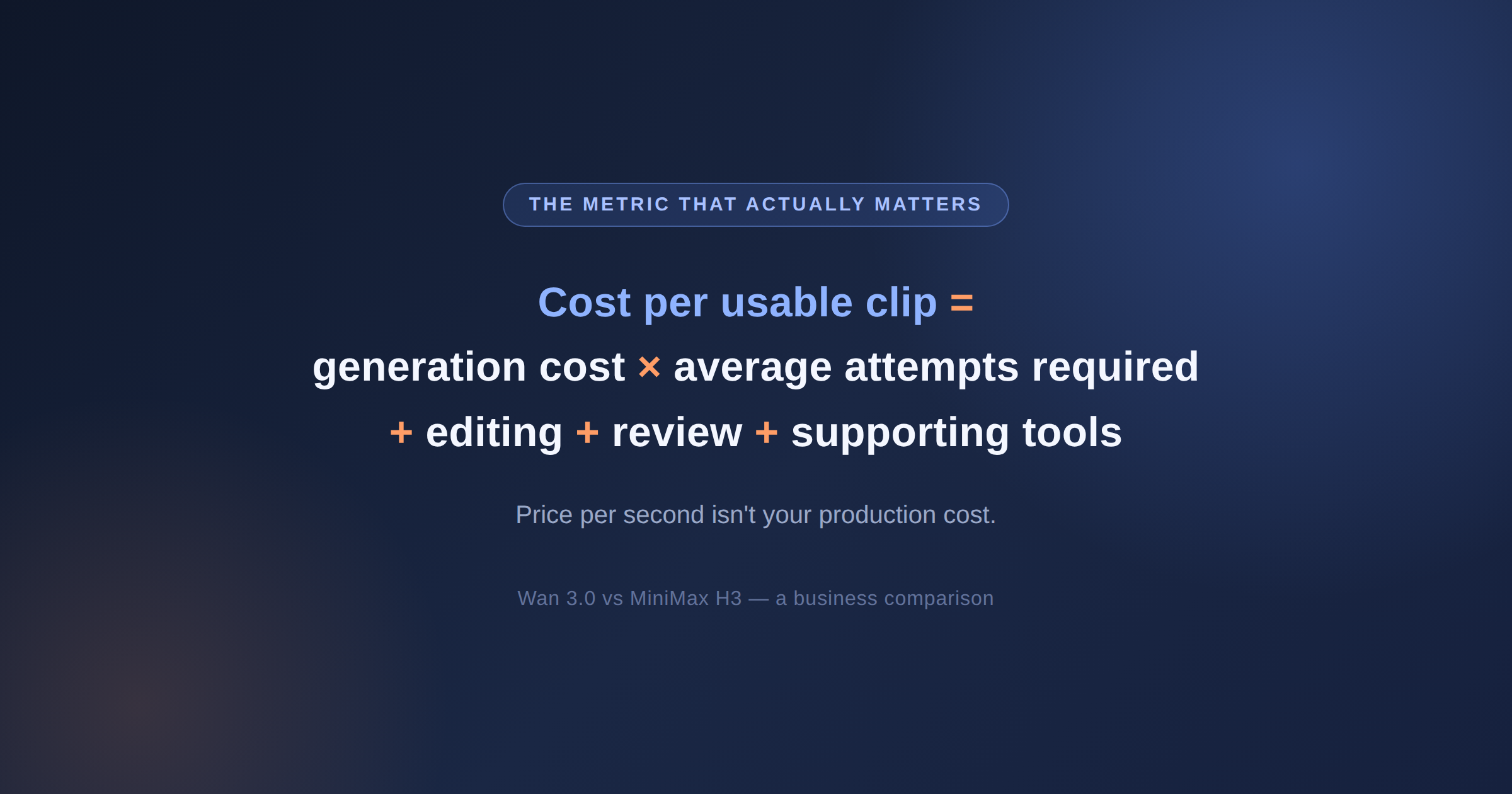
A better metric is:
Cost per usable clip = generation cost × average attempts required + editing + review + supporting tools
Imagine Model A costs less per generation but requires four attempts before a client accepts the result. Model B costs more but usually delivers a usable result in two attempts.
Model B may have the lower real production cost.
The same applies to editing.
If an unwanted camera movement requires regenerating an entire advertisement, that mistake has a direct cost. If the workflow lets the creator modify one section while keeping the accepted character, product and composition, revisions become cheaper.
This is one reason Wan 3.0’s video-editing capabilities deserve more attention than a simple resolution comparison. Alibaba describes editing of visuals, plot and dialogue without requiring the entire creative concept to be rebuilt.
Wan 3.0 has unusually transparent API pricing
Alibaba Cloud currently publishes standard Wan 3.0 list prices of:
$0.05 per second for 480P
$0.10 per second for 720P
$0.20 per second for 1080P
A temporary 30% launch promotion reduces those prices to $0.035, $0.07 and $0.14 per second respectively, available until September 24, 2026 at 00:00 (UTC+8). That works out to approximate promotional costs of $1.05, $2.10 and $4.20 for a 30-second generation at those three resolution tiers.
For a business plan, however, the temporary promotional rate should not be treated as the permanent unit economics. Budgeting should start with the standard rate and then model retry rate separately.
MiniMax H3 changes the cost equation in another way
H3 offers a hosted API, but its more unusual business advantage is the open-weight path.
MiniMax’s official workflow separates H3 into H3-Base, H3-Context-IR and H3-Regenerate-2K. The open H3-Base weights can generate locally at a 768-pixel short side, while the hosted components can provide prompt/context processing and 2K regeneration.
That creates a potentially useful commercial workflow:
iterate locally → select a keeper → send only the keeper through the higher-quality hosted stage
For a technically capable company with sufficient hardware utilization, that is potentially more interesting than paying an API for every experimental generation.
But “open weights” does not mean “zero cost.”
GPU hardware, inference optimization, storage, engineering, monitoring, moderation and idle capacity all become part of the bill.
For a small agency producing ten videos a week, managing that infrastructure may make no economic sense.
For a platform generating thousands of clips, it could.
The Hidden Cost Most Comparisons Ignore: Client Revisions
Suppose an agency generates a product advertisement.
The client replies:
Keep the same actor, bottle, voice and final composition, but slow the camera movement and change the second line of dialogue.
That request is much more revealing than a benchmark prompt.
A production model needs to preserve what the client approved while changing what the client rejected.
If every revision becomes another roll of the dice, profitability deteriorates quickly.
Wan 3.0’s advantage: longer production units
Wan 3.0 can place up to 30 seconds inside one generation.
For a 25-second social advertisement, that may allow the entire sequence to exist within one generated unit rather than three or four separate clips.
That potentially reduces:
clip stitching
continuity corrections
audio transitions
character drift between generations
additional editing passes
It is especially relevant for talking-head UGC ads, product demonstrations, trailers and short narrative advertisements.
The benefit is not simply that “30 seconds is better than 15 seconds.”
The benefit is that a larger percentage of the customer deliverable may fit inside one generation context.
MiniMax H3’s advantage: tightly controlled multimodal context
H3 takes a different approach.
Its reference workflow allows specific images, videos and audio clips to have explicit roles. A creator can define one reference as the character, another as a motion source and another as a voice reference.
MiniMax’s H3-Context-IR is designed to interpret those relationships and convert free-form multimodal instructions into a structured representation for the generation model.
That can be valuable when the requested revision is narrowly defined:
keep this person
preserve this product
copy this camera movement
use this voice
replace this action
For businesses selling highly controlled shots rather than complete 30-second stories, that distinction matters.
Same Brief, Different Prompt Strategy
Another hidden production cost is prompt engineering.
Many Wan 3.0 vs MiniMax H3 tests put exactly the same prompt into both models. That measures how portable a generic prompt is, but it does not necessarily show the best output each model can produce.
A commercial workflow should optimize the prompt for the model.
Consider this brief:
Create a luxury perfume advertisement. A woman enters a hotel suite, places a perfume bottle beside a mirror, delivers one line of dialogue, and the camera finishes on a precise product hero shot.
A Wan 3.0 version should think in time
A useful Wan-oriented prompt could organize the idea as a miniature production timeline:
0–6s: Wide tracking shot as the woman enters the suite. 6–14s: Follow her toward the dressing table while maintaining character and product consistency. 14–22s: Medium close-up as she places the perfume beside the mirror and speaks. 22–30s: Slow push toward the bottle, ending on a clean centered hero composition.
The longer generation window makes temporal progression valuable.
A MiniMax H3 version should define relationships
For H3, the same creative brief can be structured more explicitly around references:
Subject 1: woman shown in Image 1. Preserve face, hairstyle and wardrobe. Product 1: perfume bottle in Image 2. Preserve exact bottle geometry, label and cap. Motion reference: use the smooth push-in movement from Video 1 for the closing shot. Voice reference: use the timbre in Audio 1 for Subject 1.
Then describe the shot, action, dialogue, camera behavior and ending state.
Neither approach is universally superior.
The important business lesson is that prompt conversion itself becomes part of the production system.
A SaaS product should not simply forward the same raw customer prompt to every video model and expect equivalent results.
Which Is Better for an AI Video SaaS?
For an AI video SaaS, Wan 3.0 currently has a compelling practical advantage: Alibaba says the Wan 3.0 Video API is generally available with no application required.
A developer can build around a hosted service without operating the underlying video model.
That means fewer infrastructure responsibilities:
no GPU fleet
no model serving
no weight management
no inference optimization
no capacity planning at the GPU layer
Wan 3.0 also accepts documents and web pages, which creates product ideas beyond a traditional prompt box.
For example:
PDF → product videolanding page → promotional videomarketing brief → 30-second social adpresentation → campaign video
This is particularly useful for SaaS products built around workflow automation rather than professional video prompting.
Where MiniMax H3 becomes more interesting
H3 may be more attractive when the model itself is part of the company’s technical advantage.
Open weights can allow a team to:
operate its own inference stack
optimize hardware utilization
build custom preprocessing
fine-tune or develop derivative workflows
integrate with internal production systems
avoid relying exclusively on hosted inference for every stage
MiniMax explicitly documents production serving through SGLang and vLLM-based workflows.
That is a very different proposition from simply consuming an API.
For an engineering-heavy startup, it may be the more strategically interesting foundation.
For a small no-code SaaS, it may create complexity the company does not need.
Which Is Better for a Creative Agency?
For agencies, Wan 3.0 vs MiniMax H3 becomes a question of turnaround time.
Agencies usually need:
concept variations
client feedback
brand consistency
quick revisions
multiple aspect ratios
predictable delivery dates
Wan 3.0’s 30-second generation window is valuable when an agency delivers complete social spots, short ads or UGC-style videos. MiniMax H3 is particularly attractive when the agency works shot by shot and cares heavily about reference control — which fits better depends on the deliverable, not on which model is “best.”
Which Is Better for Product Ads?
Product advertising reveals another interesting difference.
A product video is not successful merely because it looks cinematic.
The bottle, sneaker, phone or package must still look like the client’s product.
The business should therefore track:
product geometry
logo integrity
label consistency
color consistency
interaction with hands
final-frame accuracy
number of correction attempts
Wan 3.0 emphasizes product consistency and positions its 30-second workflow for premium UGC and brand creative.
MiniMax says H3 is designed for commercial workflows including advertising, branding and e-commerce, with strong multimodal instruction following and brand rendering.
The practical decision should come from a repeatable test set using the company’s own products — not one impressive demo.
What Happens When You Scale From 10 Videos to 1,000?
This is where many AI video workflows break.
At ten videos, a creator can manually:
rewrite prompts
inspect every generation
rerun failures
rename files
fix audio
edit transitions
At 1,000 videos, every manual step becomes a system problem.
A scalable Wan 3.0 vs MiniMax H3 evaluation should therefore measure five things.
1. Acceptance rate
What percentage of first generations can actually be used?
This often matters more than price per second.
2. Average attempts per approved output
A cheap model with a high retry rate can become expensive quickly.
3. Human review time
If every clip requires five minutes of inspection and correction, generating faster does not solve the bottleneck.
4. Revision isolation
Can the system change one part without destroying the approved parts?
5. Infrastructure overhead
Hosted APIs simplify infrastructure.
Open weights increase control but move more operational responsibility onto the business.
The best production model is therefore not necessarily the model with the highest visual score.
It is the model that creates the most predictable cost per approved deliverable.
Commercial Use and Licensing: Do Not Skip This Section
This is where the business comparison becomes more complicated.
MiniMax H3 is officially available as open weights under the MiniMax H3 Community License, but businesses should read the license rather than treating “open-weight” as equivalent to unrestricted Apache-style use.
MiniMax states that commercial use is royalty-free under its Community License, subject to conditions. Businesses self-hosting the open weights and exceeding $20 million in annual revenue require separate written authorization from MiniMax before continuing. That threshold applies specifically to self-hosted deployment. The Community License revenue threshold does not govern hosted API use; API access is subject to MiniMax’s separate service terms. Commercial products built on the self-hosted weights must also prominently display “MiniMax H3” in the product’s user interface, and companies that host H3 as a service for others take on additional obligations, including anti-abuse safeguards and full responsibility for the outputs their users generate.
There is also an important territorial distinction. The current open-weight license excludes the United States, European Union, United Kingdom and South Korea from self-hosted commercial use. MiniMax states that its API remains available globally with safeguards, while organizations in excluded territories can apply for separate authorization for local deployment.
That means a US startup cannot simply read “open weights” and assume the local-deployment decision is finished. The licensing route needs to be evaluated first — ideally against MiniMax’s actual license text, not a summary of it, including this one.
Is MiniMax H3 open source?
Partially. MiniMax released real, downloadable H3-Base weights, so self-hosting is genuinely possible. But the Community License restricts self-hosted commercial use in the US, EU, UK, and South Korea, and requires separate authorization above $20 million in revenue. Those Community License restrictions do not govern hosted API use; the API is subject to MiniMax’s separate service terms.
Wan 3.0’s official production experience, by contrast, is centered on Alibaba Cloud Model Studio and its hosted API. The current API is generally available rather than application-gated. Alibaba has also published an official Apache-2.0 GitHub repository for Wan 3.0 — worth noting on its own merits, since it’s a genuine open-source license — but the repository currently contains documentation and licensing only, no downloadable weights, so it doesn’t change the self-hosting picture described above. Enterprise teams should also review the Alibaba Cloud region they use, the service’s data-processing terms, retention policies, and any internal data-handling restrictions before sending proprietary documents or customer assets through the document-to-video workflow.
Is Wan 3.0 open source?
Not in the way that matters for self-hosting. Alibaba publishes an official Apache-2.0 GitHub repository for Wan 3.0, but it contains documentation and licensing only — no downloadable model weights. Wan 3.0 is not currently self-hostable from publicly released weights; official production access is centered on Alibaba Cloud’s hosted API.
For companies choosing either model, legal review should cover current provider terms, generated-content requirements, intellectual-property obligations and local law before launch.
Wan 3.0 vs MiniMax H3 by Business Model
Business | Better Starting Point | Why |
|---|---|---|
AI video SaaS without ML infrastructure | Wan 3.0 | Straightforward hosted API and broad inputs |
AI infrastructure startup | MiniMax H3 | Open-weight deployment creates more technical control |
Creative agency making complete social ads | Wan 3.0 | 30-second generation can reduce stitching |
Shot-based VFX/creative studio | MiniMax H3 | Strong multimodal reference workflow |
Document-to-video SaaS | Wan 3.0 | Native document and web inputs |
Brand/product creative | Depends | Test product fidelity and revision rate |
High-control character workflow | MiniMax H3 | Explicit multimodal reference relationships |
Team that does not want GPU infrastructure | Wan 3.0 | Hosted-first production path |
Team wanting local experimentation | MiniMax H3 | Official open-weight deployment |
Business in an H3 excluded-weight territory | Wan 3.0 or H3 API | H3 local weights require separate licensing consideration |
Whichever row matches your business, test it yourself before deciding.
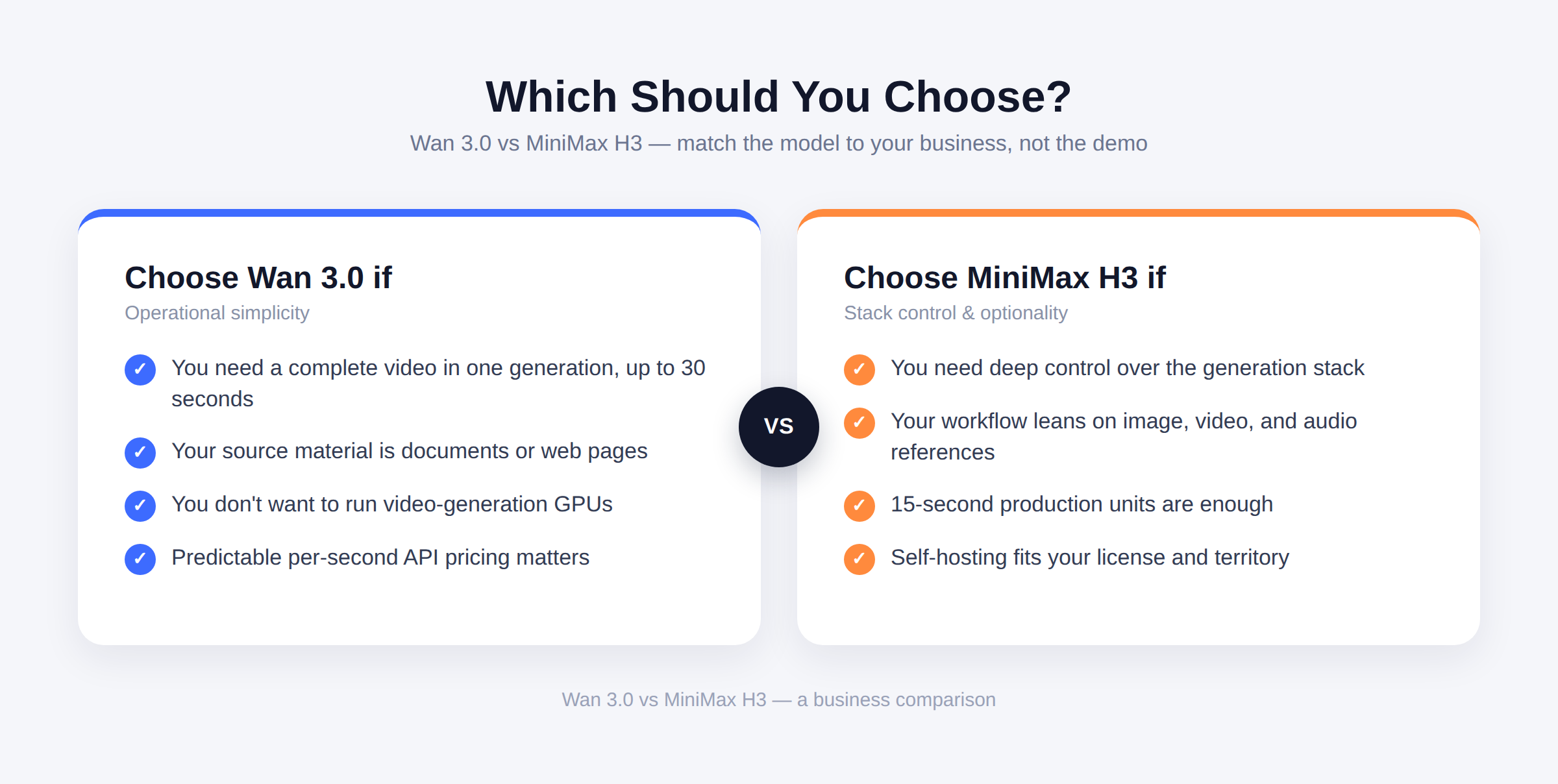
When Should You Choose Wan 3.0?
Choose Wan 3.0 when 15 seconds is too short, customers hand you documents or web pages as source material, or the business would rather not operate video-generation GPUs at all. The strongest argument for Wan 3.0 isn’t simply “30 seconds” — it’s workflow compression: more of the source material, story, and final deliverable living inside one managed generation system.
When Should You Choose MiniMax H3?
Choose MiniMax H3 when control over the generation stack matters more than minimizing infrastructure work — when the team has ML engineering capacity, the workflow leans on precise image/video/audio references, 15-second units are sufficient, and the license and territorial requirements are acceptable. The strongest H3 advantage isn’t simply 2K — it’s optionality: run the hosted system, operate H3-Base locally, or combine both as volume grows.
Final Verdict: Which Can You Actually Build a Business On?
Both.
But they support different kinds of businesses.
Wan 3.0 is currently the easier model to build around when the priority is operational simplicity — a generally available API, 30-second output, and transparent per-second pricing add up to a straightforward path from prototype to commercial production. MiniMax H3 is the more strategically flexible option for teams that want deeper ownership of the generation stack — open weights, local deployment, and a hybrid local/API workflow open doors a purely hosted model can’t. The trade-off is that flexibility introduces responsibility: infrastructure, optimization, moderation and licensing all become part of the business.
So the most useful Wan 3.0 vs MiniMax H3 question isn’t:
Which model produces the better demo?
It’s:
Which model produces an acceptable customer result with the fewest retries, the least human intervention, and a cost structure that still works at 1,000 videos?
Before choosing either, run the same real business briefs through both models and record acceptance rate, attempts per keeper, revision time and total cost per approved clip. Those four numbers will tell you far more about whether a model can support a business than another benchmark score ever will.
FAQ
Is Wan 3.0 better than MiniMax H3 for business?
Wan 3.0 may be a better starting point for API-first businesses because it provides up to 30-second generation, broad multimodal input support, editing, native audio and a generally available hosted API. MiniMax H3 can be more attractive for technically capable teams that value open weights, local deployment and deeper control over multimodal generation workflows.
Which is cheaper, Wan 3.0 or MiniMax H3?
Raw generation price alone is not enough to determine which system is cheaper. Businesses should measure cost per usable output, including retries, editing, human review and infrastructure. Wan 3.0 publishes per-second cloud API pricing, while H3 additionally provides an open-weight path that can shift part of the cost toward self-managed compute.
Can MiniMax H3 be used commercially?
Yes, MiniMax states that its Community License permits royalty-free commercial use subject to its license conditions. These include additional authorization for businesses above the stated annual-revenue threshold, product attribution requirements, acceptable-use obligations and territorial restrictions — but those specific conditions apply to self-hosted deployment of the open weights. Using MiniMax H3 through the hosted API is governed by MiniMax’s separate service terms, not the Community License revenue threshold. Companies should review the current license before deployment either way.
Can MiniMax H3 be self-hosted?
Yes. MiniMax has released H3-Base weights and official deployment instructions covering frameworks including SGLang, vLLM, Diffusers and ComfyUI. The open-weight base workflow generates at a 768-pixel short side, while the complete hosted workflow can add Context-IR processing and 2K regeneration. Territorial licensing restrictions must be checked before deployment.
Which is better for an AI video SaaS?
Wan 3.0 is likely the simpler starting point for a SaaS team that wants managed inference and does not want to operate GPU infrastructure. MiniMax H3 becomes more compelling when self-hosting, customization, infrastructure control or model-level differentiation is central to the SaaS product.
Which is better for product videos, Wan 3.0 or MiniMax H3?
Both target commercial and product workflows. The better choice should be determined by testing actual brand assets and measuring product geometry, logo accuracy, reference consistency, revision success and attempts per approved output rather than visual quality alone.
Should Wan 3.0 and MiniMax H3 use the same prompt?
Not necessarily. A fair business test should keep the creative brief constant while allowing the prompt structure to fit each model. Wan 3.0 can benefit from a longer timeline-oriented production brief, while MiniMax H3’s multimodal workflow benefits from clearly defining subjects, reference roles, actions, camera behavior, dialogue and sound.