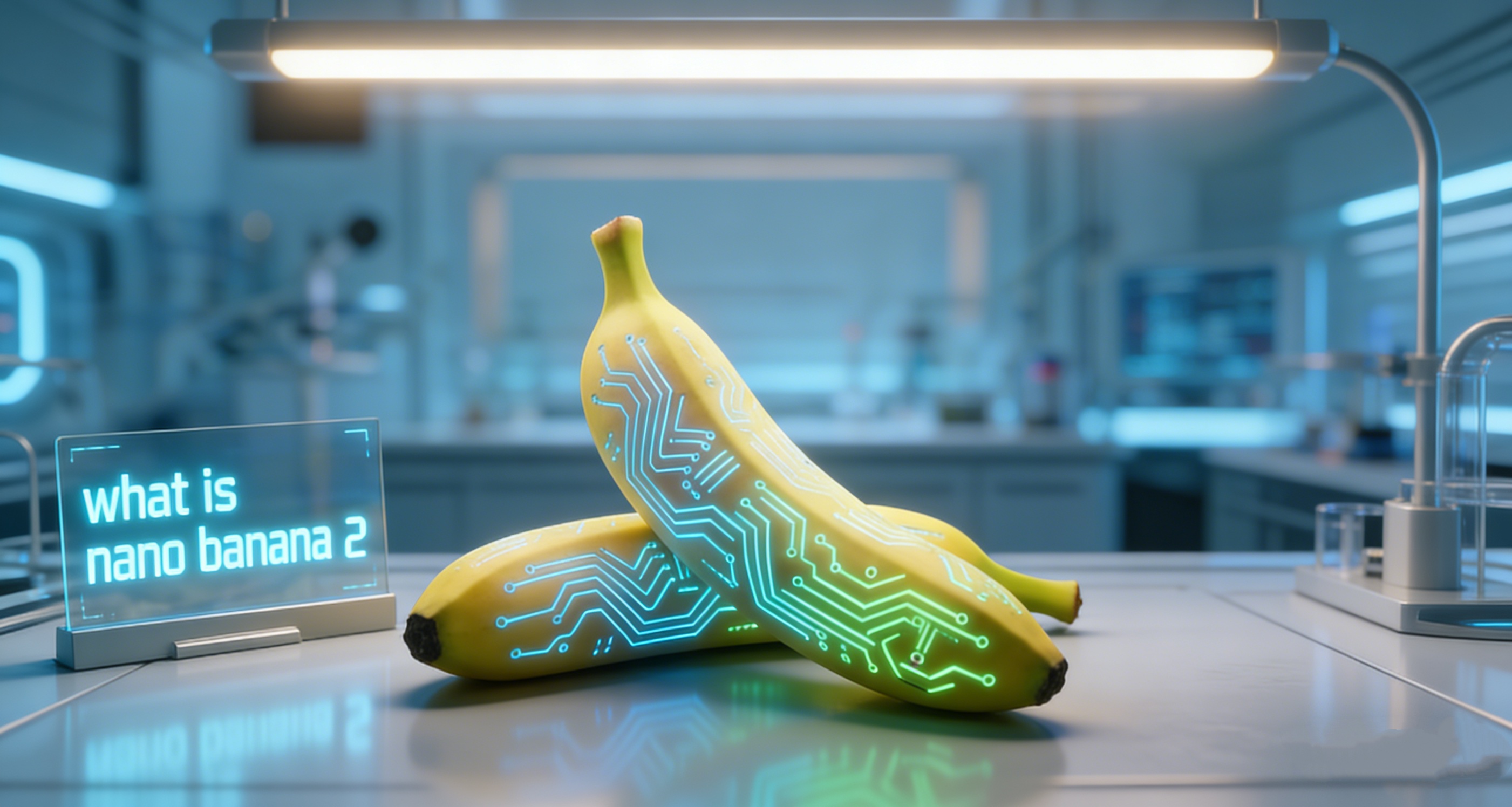
Nano Banana 2 is Google’s most advanced AI image generation model to date — and understanding what it is marks the starting point for anyone serious about AI-powered visual creation in 2026. Officially known as Gemini 3.1 Flash Image, Nano Banana 2 is engineered to deliver the output quality of a professional image model at the processing speed of Google’s fastest AI tier. It isn’t just an incremental upgrade — it’s a fundamental rethinking of what an AI image tool can be. If you want to experience it firsthand,try Nano Banana 2 here
What Is Nano Banana 2? The Core Technology Explained
So, what is Nano Banana 2 at a technical level? It is the direct successor to both the original Nano Banana (Gemini 2.5 Flash Image) and Nano Banana Pro (Gemini 3 Pro Image), combining the strengths of both into a single unified model. Launched in early 2026, Nano Banana 2 is built on the Gemini 3.1 architecture — Google’s most capable multimodal AI foundation — and is specifically fine-tuned for image generation and editing tasks.
What sets Nano Banana 2 apart from its predecessors is the elimination of the speed-quality trade-off. Earlier in the Nano Banana product line, users faced a choice: accept faster generation with slightly lower fidelity, or wait longer for Pro-grade output. Nano Banana 2 resolves this by operating at Flash speed while matching Pro-level visual quality across the vast majority of creative tasks.
Where Nano Banana 2 Is Deployed
Nano Banana 2 has become the default image generation engine across Google’s product ecosystem, including the Gemini app, Google Search AI Mode, Google Lens, the Flow video editing platform, and Google Ads creative tools. Its widespread deployment reflects Google’s confidence in the model as a production-ready standard for AI image generation.
Key Features of Nano Banana 2
Understanding what Nano Banana 2 is also means understanding what it can do. The model ships with a suite of capabilities that distinguish it clearly from both its predecessors and competing tools.
Real-World Knowledge Integration
Nano Banana 2 is deeply integrated with Gemini’s real-time web knowledge base. This gives the model the ability to generate accurate images of specific real-world subjects — landmarks, products, public figures, brand assets — with a fidelity that earlier AI image models couldn’t reliably achieve. When you ask Nano Banana 2 to depict a recognizable location or object, it draws on live world knowledge to produce a result that actually resembles the subject.
This same capability extends to data visualization. Nano Banana 2 can generate charts, annotated diagrams, and labeled infographics with meaningful accuracy, making it a practical tool for educational content, business presentations, and technical communication.
Multi-Subject Consistency
One of the most technically impressive aspects of Nano Banana 2 is its ability to maintain visual consistency across a creative workflow. The model can track and preserve the appearance of up to five distinct characters and the accurate details of up to 14 individual objects within a single project.
This capability is what makes Nano Banana 2 genuinely viable for professional storytelling, brand identity work, and serial content production. A character introduced in the first image will look the same in the fifteenth — same face, same clothing style, same distinguishing features — without any manual intervention.
Natural Language Prompt Following
What is Nano Banana 2’s approach to user input? The model is designed to interpret and execute complex, nuanced natural language prompts with a high degree of accuracy. Rather than relying on rigid keyword-based commands, Nano Banana 2 understands intent — meaning you can describe what you want in conversational language and receive results that reflect the subtleties of your description.
Multilingual Text Rendering and Localization
AI image models have historically struggled with rendering accurate text inside generated images. Nano Banana 2 addresses this with significantly enhanced in-image text generation, supporting multiple languages and complex scripts. The model can also perform text translation and localization within an image — generating the same visual asset with different language overlays — a feature with direct practical value for international marketing and global content teams.
Resolution and Format Support
Nano Banana 2 supports output from 512px up to full 4K resolution, with an extensive range of native aspect ratios. Beyond standard formats, the model supports extended ratios including 4:1, 1:4, 8:1, and 1:8 — enabling use cases from ultra-wide digital banners to tall mobile-first storytelling formats.
What Is Nano Banana 2 Used For? Real-World Use Cases
Knowing what Nano Banana 2 is becomes most meaningful when you see it applied to real creative challenges.
Brand and Marketing Asset Creation
Marketing teams use Nano Banana 2 to produce campaign visuals, product imagery, ad creatives, and social content at a pace that traditional design workflows can’t match. The model’s text localization feature is particularly valuable for brands operating across multiple language markets — a single visual concept can be adapted and localized within one generation session.
Character Design and Visual Storytelling
For illustrators, game designers, and filmmakers, Nano Banana 2’s multi-subject consistency feature transforms the character design process. Designers can establish a character’s visual identity in an early prompt and maintain that identity throughout an entire visual narrative — across dozens of scenes, poses, and environments — without manual re-drawing or style matching.
Product Visualization
E-commerce teams and product designers use Nano Banana 2 to generate photorealistic product images, lifestyle shots, and packaging mockups. The model’s high-resolution output and precision prompt-following make it suitable for producing assets that meet commercial publishing standards.
Developer and API Integration
Nano Banana 2 is accessible via the Gemini API and Google AI Studio, enabling developers to embed image generation capabilities directly into applications, automate visual content pipelines, or build creative tools on top of the model. Its speed makes it practical for real-time or near-real-time use cases at scale.
Nano Banana 2 vs. Nano Banana Pro: Understanding the Difference
A complete answer to “what is Nano Banana 2” requires placing it in context alongside Nano Banana Pro.
Nano Banana 2 (Gemini 3.1 Flash Image) is the model designed for the widest range of everyday creative and professional tasks. It prioritizes speed without sacrificing quality, making it the right choice for iterative workflows, social content, marketing production, and any project where turnaround time matters.
Nano Banana Pro (Gemini 3 Pro Image) is positioned for the most demanding use cases — projects requiring maximum factual precision, extreme rendering detail, or highly complex multi-step editing workflows. This includes large-format commercial print, high-end product photography, and technically exacting editorial imagery.
The practical implication: for the vast majority of professional creative work, Nano Banana 2 delivers equivalent or superior results to Nano Banana Pro, at significantly faster generation speeds. Nano Banana Pro remains the right tool when a project’s requirements push beyond what Flash-tier speed can accommodate — but those cases are the exception, not the rule.
How to Get the Most Out of Nano Banana 2
Now that you understand what Nano Banana 2 is, here are the core principles for using it effectively.
Write Structured, Specific Prompts
The most reliable way to get high-quality output from Nano Banana 2 is to structure your prompts deliberately. A strong prompt includes the subject, the setting or environment, the visual style or mood, and any relevant technical specifications such as aspect ratio or resolution. Vague prompts produce vague images — specificity is the primary lever for output quality.
Use Iterative Editing Instead of Regenerating
When an initial result needs refinement, use Nano Banana 2’s natural language editing capability rather than starting from scratch. Upload the generated image, describe the specific changes you want, and the model will apply targeted modifications while preserving the elements you want to keep. This approach preserves compositional and stylistic consistency while converging on your intended result far more efficiently.
Leverage Subject Consistency for Multi-Image Projects
For any project involving more than one related image, establish your characters and key objects in an early prompt and explicitly reference them in subsequent generations. Nano Banana 2’s consistency tracking will carry those visual identities forward automatically.
Nano Banana 2: The New Standard for AI Image Generation
What is Nano Banana 2, in its simplest definition? It is the point at which AI image generation became fast enough, accurate enough, and capable enough to serve as a genuine creative partner for professional work — not just a novelty tool or a prototyping shortcut. Its combination of real-world knowledge, multi-subject consistency, precision prompt execution, multilingual text rendering, and 4K output makes it the most complete AI image model currently available for everyday professional use.
Whether you are a designer exploring new workflows, a marketer scaling content production, or a developer building image-generation features into a product, Nano Banana 2 represents the current state of the art.