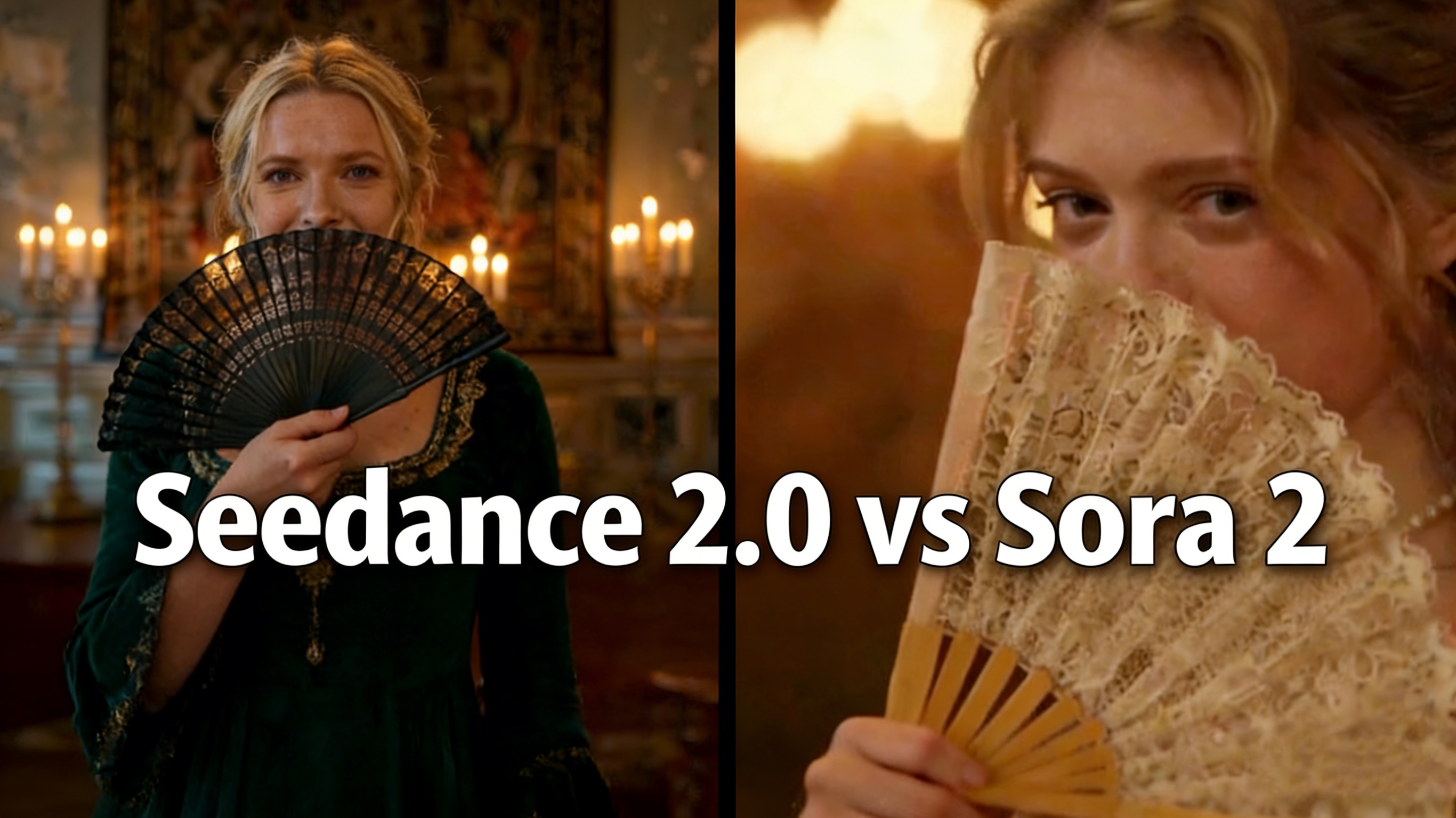
Seedance 2.0 vs Sora 2 is the most important comparison in AI video right now. Both models represent a genuine leap forward in what AI-generated video can do — but they are built around fundamentally different priorities. Seedance 2.0 is engineered for controllability, multimodal input, and repeatable production workflows. Sora 2 is built for cinematic realism and physics-driven simulation. Understanding that difference is what separates a smart tool choice from an expensive mistake.
This guide cuts through the noise and gives you a precise, dimension-by-dimension breakdown of Seedance 2.0 vs Sora 2, based on real technical capabilities and production use cases.
Core Philosophy: What Each Model Is Optimizing For
Before comparing features, you need to understand what Seedance 2.0 and Sora 2 are each trying to solve.
Seedance 2.0 is a production-oriented model. Built on a dual-branch diffusion transformer architecture released by ByteDance in February 2026, it accepts text, images, video clips, and audio simultaneously — up to 12 reference files in a single generation. The goal is structured, repeatable output that stays consistent across multiple clips, scenes, and campaign iterations.
Sora 2 is a simulation-oriented model. OpenAI designed it around photorealistic motion, environmental physics, and cinematic lighting. It generates visually striking results, often in fewer iterations — but those results can be harder to reproduce exactly when you need consistency across a production run.
This core trade-off — workflow control vs. visual realism — defines the entire Seedance 2.0 vs Sora 2 comparison.
Resolution and Visual Output
Seedance 2.0 wins on resolution.
Seedance 2.0 outputs native 2K (2160p) video, with support for 1080p and 720p. That extra fidelity matters for large-format displays, high-definition advertising, and any project where you need to crop or reframe in post.
Sora 2 maxes out at 1080p — still excellent, but a measurable step down when you need the highest possible visual quality.
Sora 2 wins on cinematic color and lighting.
Despite the resolution gap, Sora 2 produces visuals with a more photorealistic quality in the documentary and product-demo sense — nuanced lighting, accurate shadow behavior, and subtle color grading. Seedance 2.0 tends toward richer, more stylized color palettes, which suits brand content but may feel less “natural.”
Bottom line: For sharpness and export quality, Seedance 2.0. For photographic realism, Sora 2.
Video Length and Narrative Range
Sora 2 wins on duration.
Sora 2 supports continuous clips up to 25 seconds — enough to carry a complete narrative arc within a single generation. Seedance 2.0 generates 4–15 seconds per clip, optimized for short-form content: social media spots, product showcases, and templated ad formats.
Seedance 2.0 compensates with multi-shot planning.
Within its 15-second window, Seedance 2.0’s built-in narrative planner functions like a storyboard artist — breaking a complex prompt into a logical sequence of shots (wide, medium, close-up) and generating them with consistent characters and lighting across cuts. The result feels edited, not raw.
Bottom line: For a single 25-second continuous sequence, Sora 2. For multi-shot storytelling within a short window, Seedance 2.0 performs surprisingly well.
Control, Multimodal Input, and Creative Direction
This is where Seedance 2.0 vs Sora 2 diverges most sharply — and where Seedance 2.0 wins decisively.
Seedance 2.0: The @ Reference System
Seedance 2.0’s quad-modal input system accepts:
Up to 9 reference images
Up to 3 video clips
Up to 3 audio tracks
Text prompts
More importantly, its @ Reference System lets you bind uploaded assets to specific roles in your prompt. Write “@hero walks through a neon-lit alley” and attach a character photo — the model locks that face, outfit, and visual identity across every generated frame. The same logic applies to camera movements, motion styles, and audio references.
This means you can maintain brand characters, product appearances, and audio identity across an entire campaign — not just a single clip.
Sora 2: Text-First Generation
Sora 2 works primarily with text prompts and single reference images. Its Cameo feature allows you to place a photo of yourself into a scene, which is useful for personalized content. But it offers no equivalent to Seedance 2.0’s structured multi-asset reference system.
For creators who have specific visual assets — character designs, motion references, brand audio — Seedance 2.0 is the only tool that can take all of those inputs simultaneously and produce output aligned to all of them.
Bottom line: If creative control and reference fidelity matter to your project, this isn’t even close. Seedance 2.0 wins.
Physics Realism and Motion Quality
Sora 2 wins on physics accuracy.
This is Sora 2’s defining strength. Its physics engine handles gravity, fluid dynamics, material deformation, and complex light refraction with best-in-class accuracy. A basketball bounces exactly right. Fabric moves convincingly in wind. Multi-object collision sequences play out with physical conviction that most models can’t match.
Seedance 2.0 is excellent for everyday physics.
Seedance 2.0 has made significant strides here — everyday motion scenarios (walking, pouring, falling objects) look clean and stable, as verified by internal benchmarks on SeedVideoBench-2.0. But in highly complex multi-object or fluid simulation scenarios, Sora 2 still holds a measurable edge.
Bottom line: For standard commercial motion, Seedance 2.0 is more than adequate. For extreme physics simulation, Sora 2 leads.
Native Audio Generation
Both models generate native audio — a major advantage over older tools that layered sound on top of visuals after the fact.
Seedance 2.0: Audio as an input, not just an output.
Seedance 2.0’s dual-branch diffusion transformer processes video and audio latents in parallel during generation. This means sound is synchronized at the frame level — a glass breaks and the sound lands on exactly the same millisecond. More importantly, you can upload an audio reference and the model will generate the video’s sound based on that input. This is invaluable for commercial dubbing, brand audio consistency, and music video production.
Sora 2: Strong English dialogue quality.
Sora 2’s native audio output is polished, particularly for English dialogue. Pacing and inflection tend to sound natural. Seedance 2.0 occasionally rushes dialogue when the time window is short relative to the script length.
Bottom line: For audio reference input and sound-design control, Seedance 2.0. For natural-sounding English dialogue, Sora 2 has a slight edge.
Generation Speed
Seedance 2.0 is approximately 30% faster.
Powered by its RayFlow generation architecture, Seedance 2.0 outpaces Sora 2’s standard diffusion pipeline by a significant margin. For production workflows that require high-volume iteration — running dozens of variations to land on the right output — this speed advantage compounds into real time savings across a project.
Character Consistency Across Multiple Clips
Seedance 2.0 wins for multi-clip consistency.
Within a single generated clip, both models track characters reasonably well. But across multiple separate generations featuring the same character, Sora 2’s consistency becomes unpredictable without careful, repetitive prompt engineering.
Seedance 2.0’s @ Reference System solves this structurally. Attach a reference image to a character tag once, and that face, clothing, and visual identity persists reliably across different scenes and shoots — making it the clear choice for series content, brand storytelling, and multi-video campaigns.
Full Feature Comparison Table
Feature | Seedance 2.0 | Sora 2 |
|---|---|---|
Max Resolution | 2K (2160p) | 1080p |
Video Length | 4–15 seconds | 5–25 seconds |
Multimodal Inputs | 12 files (text + image + video + audio) | Text + 1 image |
Native Audio | Yes — with audio reference input | Yes |
Physics Realism | Excellent | Best-in-class |
Generation Speed | ~30% faster (RayFlow) | Standard |
Multi-Clip Character Consistency | Strong (@ Reference System) | Variable |
Multi-Shot Narrative Planning | Built-in | Not available |
Best For | Production workflows, brand content | Cinematic realism, long-form narrative |
Who Should Use Seedance 2.0?
Seedance 2.0 is the right choice when you have specific creative assets to work from and need the output to stay faithful to those assets across multiple clips.
It is particularly well-suited for:
Marketing and advertising teams — maintain brand characters, product visuals, and audio identity at scale
Social media content pipelines — high-speed generation in all major aspect ratios (16:9, 9:16, 4:3, 1:1, and more)
E-commerce and product video — reference the product image and generate multiple consistent showcase angles
Agency client work — repeatable, prompt-driven workflows that can be reproduced for revisions and approvals
Anime and stylized character content — the @ system keeps outfits, hair color, and expressions consistent across multi-scene sequences
Who Should Use Sora 2?
Sora 2 is the stronger choice when:
You need a single, continuous sequence longer than 15 seconds
Physical realism is non-negotiable (architecture, product physics, natural environments)
You are producing standalone cinematic or experimental pieces where consistency across multiple clips is not required
Natural English dialogue pacing matters more than audio reference control
The Smartest Strategy for 2026: Use Both
The Seedance 2.0 vs Sora 2 decision is not always binary. For professional creators, the most effective approach is to use them in combination.
Use Seedance 2.0 for reference-heavy scenes, brand content, social media clips, and any workflow that requires high-volume iteration with predictable results.
Use Sora 2 when a shot needs extreme physics accuracy, an unusually long continuous sequence, or a level of cinematic naturalism that pushes beyond what Seedance 2.0 currently offers.
These two models complement each other. Knowing when to switch between them is the skill that separates good AI video work from great AI video work.
Start Creating with Seedance 2.0
If your work involves structured production — campaigns, product videos, brand storytelling, or social content pipelines — Seedance 2.0 gives you more control, more input flexibility, faster iteration, and better multi-clip consistency than any other model available today.
The workflow is straightforward: upload your reference assets, assign them to roles using the @ system, set your aspect ratio, generate, and refine. No full production team required.